Table of Contents
- Understanding Business Vehicle Fleet Planning
- Cost Efficiency and Total Cost of Ownership
- Fleet Management Best Practices for Growth
- Fleet Vehicle Replacement Policy and Lifecycle Management
- Fleet Management Software Benefits and Data-Driven Insights
- In-House vs. Outsourced Fleet: Planning Your Approach
- Transition Roadmap and Change Management
- Sustainability and ESG Reporting in Fleet Planning
Last Updated: June 2026
Understanding Business Vehicle Fleet Planning
Effective business vehicle fleet planning sits at the heart of operational efficiency for any organisation that depends on transport. Get it wrong and you face spiralling costs, compliance gaps, and unsupported drivers. Get it right and your fleet becomes a competitive asset. This guide covers everything from total cost of ownership to transition roadmaps, enabling confident decision-making.
Most businesses underestimate the true scope of fleet planning until something goes wrong: a vehicle breaks down at a critical moment, a driver fails a compliance check, or an unexpected fuel bill arrives. These are symptoms of planning gaps, and each is preventable.
According to the Department for Transport's fleet statistics guidance, commercial vehicle fleets account for a significant proportion of total road miles in the UK, making fleet efficiency decisions consequential for both individual businesses and national transport outcomes.
Cost Efficiency and Total Cost of Ownership
Total cost of ownership (TCO) is the complete financial picture of running a vehicle across its entire operational life, encompassing acquisition, fuel, maintenance, insurance, taxation, and disposal value. TCO is the only metric that gives you an honest comparison between fleet options.
Capital Investment vs. Operational Expenses
The choice between owning vehicles outright and leasing them is fundamentally a question of capital allocation. Purchasing ties up significant working capital in depreciating assets. Leasing converts that capital expenditure into a predictable operational expense, preserving cash for core business investment.
A common mistake is comparing the monthly lease payment against the loan repayment and calling it even. The real comparison includes residual value risk, maintenance provisions, and administrative overhead. When you own a fleet, you absorb full depreciation risk. Contract hire transfers that risk to the leasing provider. Many businesses find that exploring Vehicle Leasing Special Offers and Van Leasing Special Offers provides a clearer picture of what modern leasing arrangements can deliver compared to traditional ownership models.
Fuel Management and Vehicle Downtime
Fuel is typically one of the largest variable costs in any fleet budget and one of the most controllable. Telematics data showing idling time, harsh acceleration, and route inefficiency can directly reduce fuel spend without requiring capital outlay.
Vehicle downtime compounds the cost problem. Every day a van sits off the road is a day of lost productivity. Preventative maintenance schedules reduce unplanned downtime significantly compared to reactive repair models.
Fleet Management Best Practices for Growth
The most effective fleet management practices share a common principle: decisions should be driven by data, not habit.
Asset Utilisation and Fleet Optimisation
Asset utilisation measures how productively each vehicle is being used relative to its capacity. A van completing three deliveries per day when it could handle five is a utilisation problem. Fleet optimisation starts with understanding actual utilisation patterns, then right-sizing the fleet accordingly.
Overstaffing your fleet is a hidden cost that compounds annually. Key areas to audit regularly include daily mileage per vehicle versus capacity, idle time, route duplication, seasonal demand fluctuations, and vehicle type matching to actual load requirements.
Preventative Maintenance and Compliance
Preventative maintenance is a scheduled programme of inspections and servicing designed to identify and address wear before it causes failure. Reactive maintenance consistently costs more per incident and introduces unpredictable downtime.
Compliance sits alongside maintenance as non-negotiable. Operators' licences, driver licence checks, tachograph compliance, and roadworthiness standards all carry legal obligations. A missed check can result in prohibition notices, fines, or reputational damage.
Fleet Vehicle Replacement Policy and Lifecycle Management
A fleet vehicle replacement policy defines the criteria and triggers for retiring vehicles from service. Without a formal policy, replacement decisions tend to be reactive, driven by breakdown rather than strategy.
Timing Your Replacement Strategy
The optimal replacement point balances depreciation curves, maintenance cost escalation, and residual values. Vehicles held too long accumulate disproportionate repair costs. Vehicles replaced too early leave residual value on the table.
Fleet lifecycle management requires tracking each vehicle's whole life cost trajectory. As a vehicle ages, maintenance costs typically increase while residual value falls. The crossover point where holding costs exceed replacement costs is your optimal disposal trigger.
Replacement Trigger | Indicator | Action |
|---|---|---|
Mileage threshold | Exceeds policy limit (e.g. 100,000 miles) | Initiate replacement order |
Age threshold | Exceeds policy term (e.g. 4 years) | Review residual value and dispose |
Maintenance cost escalation | Repair costs exceed monthly lease equivalent | Accelerate replacement |
Compliance risk | Upcoming emissions regulation change | Review early replacement case |
Driver satisfaction | Repeated driver complaints or retention issues | Prioritise replacement |
Scalability and Future Business Growth
A fleet that works today may not serve your business in three years. Contract hire arrangements allow you to add or remove vehicles with greater flexibility than ownership, making them suited to businesses with variable or growing transport needs.
Business growth planning should include fleet scenario modelling: what does your fleet look like if headcount grows by 20%? If you expand into a new region? Businesses that model these scenarios ahead of time respond faster and at lower cost than those caught unprepared.
Fleet Management Software Benefits and Data-Driven Insights
Fleet management software centralises vehicle data, automates compliance tracking, and generates the operational insights needed for informed decision-making. The shift from spreadsheet-based administration to dedicated fleet software is one of the clearest efficiency gains available.
Telematics and Real-Time Fleet Tracking
Telematics refers to the integrated use of GPS tracking, vehicle diagnostics, and driver behaviour monitoring to generate real-time operational data. Modern telematics platforms capture vehicle location, engine fault codes, fuel consumption patterns, and driver scoring.
Real-time fleet tracking transforms reactive management into proactive oversight. You can see where every vehicle is, identify route deviations, respond to incidents faster, and build evidence for insurance negotiations and compliance audits.
Data-driven insights from telematics support driver productivity conversations. Rather than subjective feedback, managers can discuss specific metrics: average speed, idling percentage, harsh braking frequency. Drivers respond better to objective data than anecdotal observations.
According to the DVSA's guide to fleet operator responsibilities, maintaining accurate records of vehicle use and driver behaviour is a core element of responsible fleet operation, and telematics systems provide reliable automatic documentation.
In-House vs. Outsourced Fleet: Planning Your Approach
The in-house versus outsourced fleet decision is one of the most consequential choices in business vehicle fleet planning.
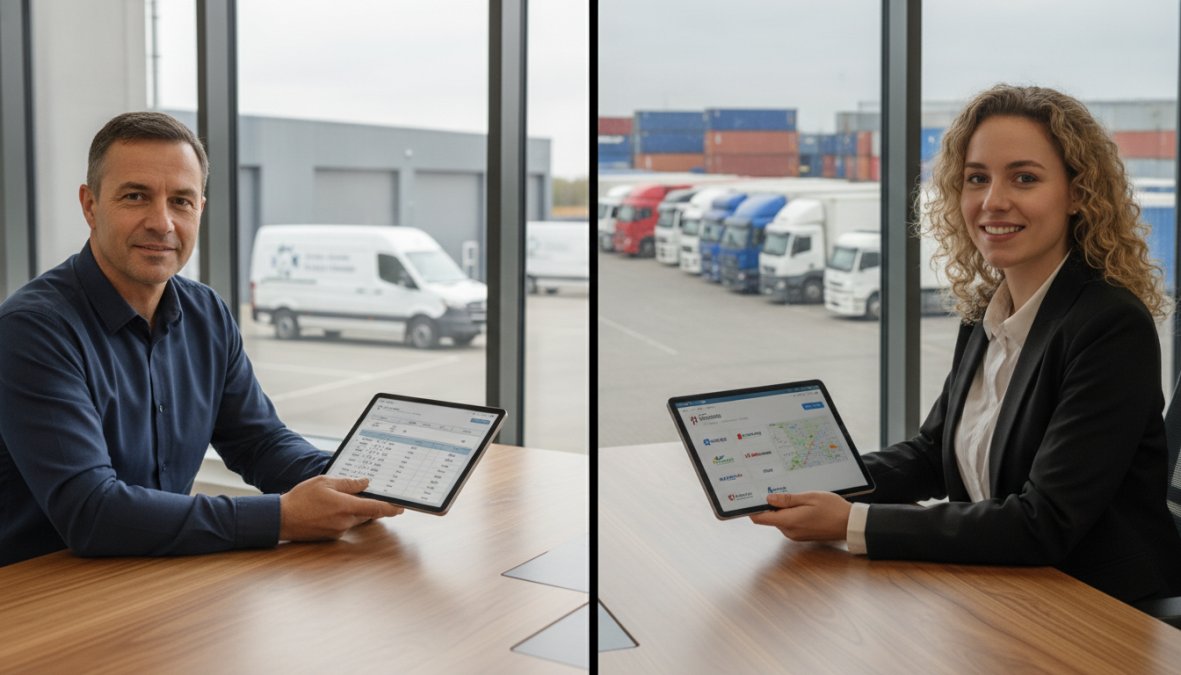
In-house fleet management gives you direct control over every decision. You hire drivers, manage maintenance schedules, and retain full visibility of operations. The trade-off is absorbing all administrative complexity, regulatory risk, and capital requirements.
Outsourced fleet management transfers operational responsibility to a specialist provider. You gain access to industry expertise, established supplier networks, and technology platforms that would be costly to replicate internally. The trade-off is reduced direct control and dependency on service level agreements.
Industry Expertise and Service Level Agreements
Outsourced fleet providers bring accumulated knowledge of vehicle markets, maintenance networks, and regulatory requirements. This expertise translates into better purchasing terms, faster problem resolution, and fewer compliance gaps.
Service level agreements (SLAs) protect you in an outsourced arrangement by defining response times, vehicle availability guarantees, reporting frequencies, and escalation procedures. The most common SLA gap is the absence of meaningful remedies when performance falls short.
Risk Mitigation and Regulatory Compliance
Outsourcing does not eliminate compliance responsibility. The legal obligation to operate roadworthy vehicles with licenced drivers remains with the business. What outsourcing does is distribute the operational burden of meeting that obligation.
Specialist providers maintain dedicated compliance teams and technology systems to track obligations continuously, which is difficult to replicate cost-effectively at small fleet scale.
Transition Roadmap and Change Management
Most guides focus on the destination of good fleet management. Fewer address the journey from where you are now to where you want to be. That gap is where most implementations fail.
A transition roadmap should work backwards from the target operating model. Define what success looks like in 12 months, then identify dependencies: technology procurement, supplier contracts, driver communication, policy documentation, and training requirements.
Change management is consistently underestimated. Drivers who feel a new system is imposed without explanation will resist it. Involving drivers early, explaining the rationale, and addressing concerns before go-live reduces friction significantly. A phased approach typically outperforms a big-bang transition.
Contractual Considerations and Implementation
Contractual pitfalls in fleet outsourcing are common and expensive. Key areas include exit clauses and early termination penalties, excess mileage charges, maintenance inclusions (tyres, glass, and accident damage are frequently excluded), price review mechanisms, and data ownership after contract end.
Getting independent legal review of fleet contracts before signing is worth the cost. The financial exposure from a poorly structured five-year agreement can be substantial.
Sustainability and ESG Reporting in Fleet Planning
Sustainability has moved from a reputational consideration to a regulatory and commercial requirement. Fleet operations are a material source of carbon emissions for any organisation relying on road transport.
According to the Carbon Trust's guidance on transport emissions reduction, transport typically represents one of the largest controllable categories of business carbon emissions, making fleet electrification and efficiency improvements high-priority actions for organisations with net-zero commitments.
ESG reporting requires accurate data on fuel consumption, vehicle emissions profiles, and mileage by vehicle type. Telematics systems that capture this data automatically are far more reliable for reporting purposes than manual records.
The shift to electric vehicles is the most significant structural change in fleet planning for 2026 and beyond. Battery electric vehicles carry lower whole life costs for high-mileage applications, generate zero tailpipe emissions, and attract favourable benefit-in-kind tax treatment for drivers. Options such as Electric / Hybrid Leasing and Lease Used Electric Vehicles make it easier for businesses to integrate electric vehicles into their fleet replacement cycles without the full capital outlay of ownership.
Salary sacrifice schemes represent an additional ESG lever. By making electric vehicles accessible to employees through tax-efficient salary arrangements, businesses can reduce the emissions profile of their workforce's personal transport alongside their commercial fleet.
The businesses that will meet future emissions regulations without disruption are those building electrification into their fleet replacement cycles now, not those waiting for regulatory deadlines to force the issue.
Effective business vehicle fleet planning requires decisions across cost management, compliance, technology, and sustainability simultaneously. OVL Group provides tailored fleet leasing and management solutions with whole life cost analysis, dedicated account management, and access to electric and hybrid vehicle options that make the transition to a modern, efficient fleet straightforward.
Frequently Asked Questions
What is the importance of fleet planning for businesses?
Effective business vehicle fleet planning directly impacts operational costs, regulatory compliance, and driver productivity. A structured approach enables businesses to optimise asset utilisation, reduce capital investment risk, and align fleet composition with supply chain efficiency goals. Without proper planning, companies face unpredictable downtime, safety risks, and unnecessary expenditure on vehicles that don't match operational requirements.
How do you calculate the total cost of ownership for a fleet?
Total cost of ownership (TCO) encompasses capital investment, fuel costs, maintenance and repairs (SMR), insurance, tax, and administrative overhead. When calculating fleet total cost of ownership, analyse the full lifecycle of each vehicle type, including depreciation and residual value. This comprehensive view reveals the true operational costs and helps justify outsourcing decisions or fleet replacement investments.
What are the key components of a vehicle fleet management plan?
A comprehensive fleet management plan includes vehicle acquisition strategy, preventative maintenance schedules, driver safety protocols, regulatory compliance frameworks, fuel management systems, and performance metrics. Fleet management software benefits include telematics integration for real-time fleet tracking, data-driven insights for optimisation, and automated reporting for compliance. Each component supports operational efficiency and risk mitigation.
What technology is essential for modern business vehicle fleet planning?
Fleet management software with telematics capabilities enables real-time vehicle tracking, driver behaviour monitoring, and predictive maintenance alerts. These tools generate data-driven insights that optimise fuel consumption, reduce vehicle downtime, and improve driver retention through better route planning. Modern platforms also simplify compliance reporting and integrate with financial systems for transparent cost analysis.