Table of Contents
- Understanding Commercial Minibus Leasing for Public Sector Organisations
- Public Sector Procurement Frameworks and Crown Commercial Service
- Minibus Leasing Regulations and Compliance Requirements in the UK
- Accessible Minibus Leasing for Public Sector Services
- Electric Minibus Leasing for Public Sector: Transitioning to EV
- Community Transport Minibus Funding and Budget Management
- Salary Sacrifice Schemes and Tax-Efficient Fleet Solutions
- Selecting the Right Minibus Leasing Partner for Public Sector Needs
Commercial Minibus Leasing for Public Sector: 2026 Guide
Last Updated: July 26, 2026
Understanding Commercial Minibus Leasing for Public Sector Organisations
Commercial minibus leasing for public sector organisations has become increasingly sophisticated, moving beyond simple vehicle rental. Today's public sector procurement demands a comprehensive approach balancing compliance, cost control, and operational flexibility. At OVL Group, we've observed that many public bodies treat minibus leasing as a commodity purchase rather than a strategic asset, missing opportunities to optimise fleet performance and reduce total cost of ownership.
Commercial minibus leasing for public sector services involves navigating complex procurement frameworks, regulatory compliance requirements, and specialist vehicle specifications that differ significantly from standard commercial leasing. Whether managing community transport, care services, or local authority operations, the requirements are more stringent than typical fleet management.
This guide covers essential considerations for public sector organisations implementing or refreshing their minibus leasing strategy. We examine procurement frameworks, compliance obligations, vehicle specifications, and financial models that deliver value. The five key areas explored have helped dozens of public sector teams reduce administrative burden, improve duty of care compliance, and achieve genuine cost savings.
Public Sector Procurement Frameworks and Crown Commercial Service
Understanding the procurement landscape is where most public sector organisations begin their minibus leasing journey. The Crown Commercial Service (CCS) provides standardised frameworks that simplify tendering and ensure compliance with public procurement regulations.
RM6268 Framework and Tender Processes
The RM6268 framework is one of the most widely used routes for vehicle leasing across UK public bodies. This framework pre-qualifies suppliers and establishes agreed terms, significantly reducing procurement complexity compared to open tender processes. You define specific requirements, vehicle type, lease duration, mileage allowance, maintenance inclusions, and suppliers respond with fixed pricing within framework terms.
The framework includes mandatory compliance checks. All suppliers must demonstrate appropriate insurance, maintenance capability, and safety standards before approval, reducing your due diligence workload significantly.
Market Engagement and Contract Hire Options
Beyond RM6268, many public bodies conduct formal market engagement for larger fleet requirements. Contract hire agreements typically span 2-5 years, with monthly rental payments covering the vehicle, maintenance, breakdown cover, and often insurance. For public sector budgeting, this provides cost predictability and enables confident expenditure forecasting.
Minibus Leasing Regulations and Compliance Requirements in the UK
Regulatory compliance underpins every commercial minibus leasing decision in the public sector. Public bodies operate under heightened scrutiny regarding vehicle safety, driver competency, and duty of care obligations.
Vehicle Safety Standards and Emissions Compliance
All minibuses operated by UK public sector organisations must comply with current safety standards. Vehicles carrying more than eight passengers are classified as Public Service Vehicles (PSVs) and require operator licensing from the relevant traffic commissioner. Your leasing contract must accommodate PSV certification, regular safety inspections, and compliance with the Public Service Vehicle Accessibility Regulations (PSVR).
Emissions compliance has tightened significantly. Many local authorities implement low-emission zones (LEZs) that restrict older diesel vehicles. When leasing minibuses, ensure vehicles meet the emissions standard required by your operating area. Euro 6 compliance is now standard for new leases, and many authorities actively transition to electric minibuses to exceed baseline requirements.
Driver Training and Duty of Care Obligations
Public sector minibus operators have explicit duty of care obligations toward passengers. This extends beyond basic driving competency to include passenger safety procedures, emergency response training, and safeguarding awareness, particularly when transporting vulnerable passengers.
Your minibus leasing contract should explicitly state that the supplier will support driver training and competency assessment. Many leasing providers now offer driver training packages covering passenger assistance, wheelchair securing, emergency procedures, and safeguarding principles. Documentation and compliance records are essential. Your leasing partner should provide a management system that tracks these compliance records automatically.
Accessible Minibus Leasing for Public Sector Services
Accessibility requirements distinguish public sector minibus leasing from general commercial vehicle hire. Whether operating community transport, care services, or local authority services, you'll likely need vehicles equipped for wheelchair users and passengers with mobility challenges.
Specialist Vehicle Specifications and Care Sector Requirements
Accessible minibuses typically include hydraulic wheelchair lifts, securing systems, handrails, wider doorways, and lowered step heights. These specifications are often mandatory under the Equality Act 2010 and essential for serving your passenger base effectively.
When specifying an accessible minibus lease, work closely with your supplier to define exact requirements. Wheelchair lift capacity, internal layout, seating configuration, and additional safety features all impact vehicle cost and ongoing maintenance. Some public bodies lease a mixed fleet, standard and fully accessible vehicles, to optimise both cost and service provision.
Care sector organisations have additional requirements. Vehicles may need to accommodate stretchers, hoists, or specialist seating for passengers with complex needs. These bespoke specifications mean generic minibus leasing quotes rarely apply; you'll need supplier input during specification to ensure vehicles meet operational requirements.
Electric Minibus Leasing for Public Sector: Transitioning to EV
The transition to electric minibuses represents one of the most significant shifts in public sector fleet management. Many local authorities actively replace diesel minibuses with electric alternatives, driven by emissions targets, air quality concerns, and increasingly attractive total cost of ownership economics.
Electric minibus technology has matured substantially. Vehicles from manufacturers including Mercedes-Benz, Volkswagen, and Ford now offer ranges of 150-250 miles per charge, making them viable for most public sector applications. Battery costs have fallen, and leasing structures now make electric minibuses competitive with diesel alternatives when accounting for fuel savings and reduced maintenance.
If you're exploring electric options, OVL Group's [Electric / Hybrid Leasing](https://www.ovl.co.uk/electric-hybrid-leasing) service provides specialist support for organisations transitioning to zero-emission vehicles, including detailed total cost of ownership analysis and charging infrastructure planning.
Total Cost of Ownership and Operational Efficiency
The total cost of ownership (TCO) for electric minibuses includes vehicle lease cost, electricity, maintenance, insurance, and residual value. When modelled across a 4-5 year lease term, electric minibuses often deliver lower TCO than equivalent diesel vehicles.
Electricity costs are typically 60-70% lower than diesel fuel per mile. Maintenance costs are significantly lower because electric vehicles have fewer moving parts, no oil changes, and regenerative braking reduces brake wear. Over a 5-year lease, fuel and maintenance savings can be substantial, enabling public bodies to reallocate savings toward other operational priorities.
Maintenance Packages and Residual Value Considerations
Electric minibus leasing contracts typically include comprehensive maintenance packages because the supplier retains residual value risk. For public sector organisations, this removes uncertainty about unexpected battery replacement costs or major repairs.
When evaluating electric minibus leases, clarify what maintenance is included. Comprehensive packages should cover scheduled servicing, battery health monitoring, software updates, and warranty coverage. Some suppliers offer battery performance guarantees, ensuring the battery retains at least 80% capacity over the lease term.
Community Transport Minibus Funding and Budget Management
Community transport organisations often operate on tightly constrained budgets, making minibus leasing decisions particularly consequential. Strategic leasing choices can free up capital for service delivery while maintaining vehicle quality and compliance.
Cost Management Through Lease Duration and Finance Options
Lease duration significantly impacts monthly costs. A 3-year lease typically costs more per month than a 4-5 year lease for the same vehicle. However, shorter leases offer flexibility to upgrade to newer vehicles more frequently, incorporating new safety features or emissions standards without major capital outlay.
Many community transport organisations find that 4-year leases strike the right balance between cost predictability and flexibility. This duration aligns with major vehicle technology cycles and allows transition to electric minibuses or new safety systems without being locked into outdated specifications.
Mileage allowances require careful consideration. Most leases include an annual mileage cap, typically 40,000-60,000 miles for community transport vehicles. Exceeding this triggers excess mileage charges. Analysing your actual mileage patterns over 2-3 years before leasing helps you negotiate appropriate allowances.
Salary Sacrifice Schemes and Tax-Efficient Fleet Solutions
For organisations with employee-owned vehicles or those offering car allowances to staff, salary sacrifice schemes present tax-efficient alternatives. These arrangements allow employees to sacrifice salary in exchange for a leased vehicle, reducing both employee income tax and employer National Insurance contributions.
Salary sacrifice minibus schemes are less common than car schemes, but increasingly available for organisations operating staff minibuses. HMRC rules governing salary sacrifice schemes are strict. The arrangement must be documented clearly, with proper salary reduction agreements in place before the vehicle is provided. Your leasing partner should be familiar with salary sacrifice compliance and able to support the administration required.
Selecting the Right Minibus Leasing Partner for Public Sector Needs
Choosing a minibus leasing supplier is perhaps the most consequential decision in your procurement process. The wrong partner creates ongoing friction, compliance risks, and hidden costs. The right partner becomes an extension of your fleet management team.
Fleet Management Consultancy and Whole Life Cost Analysis
Leading minibus leasing providers go beyond simply supplying vehicles. They offer consultancy services that help you understand your total cost of ownership, optimise fleet composition, and plan vehicle transitions strategically. This approach is particularly valuable for public sector organisations managing complex fleet requirements.
Whole life cost analysis examines not just monthly lease payments but also fuel, maintenance, insurance, tax, and residual value. A supplier offering genuine consultancy will model different scenarios, comparing diesel versus electric, different lease durations, and various vehicle specifications, to identify the option that delivers best value for your circumstances.
Dedicated Account Management and Support
Public sector minibus leasing involves ongoing administration and support requirements. Your supplier should assign a dedicated account manager who understands your operational context, compliance obligations, and strategic priorities.
Account management quality varies significantly. The best suppliers maintain smaller account bases, allowing managers to develop genuine understanding of your business and anticipate issues before they become problems. When selecting a supplier, discuss account management structure explicitly. How many customers will your account manager support? What's the process for escalating urgent issues? How frequently will you meet to review performance and plan future requirements?
OVL Group specialises in tailored minibus leasing for public sector organisations, combining specialist vehicle expertise with dedicated account management and whole life cost analysis. Our team understands the procurement frameworks, compliance requirements, and operational complexities that define public sector minibus leasing. We've supported care sector organisations, local authorities, and community transport providers to optimise their fleet performance whilst maintaining full regulatory compliance. We also offer Vehicle Leasing Special Offers that can help budget-conscious public bodies achieve additional savings on their fleet investments.
Selecting a minibus leasing partner is about finding a supplier who understands your sector's unique requirements and can support your operational and strategic objectives. The right partner reduces administrative burden, improves compliance confidence, and delivers genuine cost savings. OVL Group's whole life cost analysis, dedicated account management, and deep public sector expertise make us the natural choice for organisations serious about optimising their minibus leasing strategy. Get in touch with our team to discuss how we can support your fleet requirements and help you achieve better outcomes across cost, compliance, and service delivery.
| Consideration | Impact on Decision | Evaluation Method |
|---|---|---|
| Procurement framework compliance | Critical, non-compliance creates legal risk | Verify supplier's CCS accreditation and RM6268 status |
| Vehicle specifications | Essential, wrong specs compromise service delivery | Request detailed specification documentation and site visits |
| Maintenance and support | High, directly affects operational reliability | Review maintenance package inclusions and response times |
| Account management | High, impacts ongoing satisfaction and compliance | Discuss account manager allocation and communication frequency |
| Total cost of ownership | Critical, determines budget impact | Request full TCO modelling across lease term |
| Emissions compliance | Essential, regulatory requirement | Confirm vehicle emissions standards and LEZ compliance |
| Lease Duration | Flexibility | Best For |
|---|---|---|
| 2-3 years | High, upgrade frequently | Organisations with rapidly changing needs |
| 4 years | Balanced | Most public sector organisations |
| 5 years | Limited | Budget-constrained organisations with stable requirements |
Frequently Asked Questions
What's the difference between contract hire and finance lease for public sector minibuses?
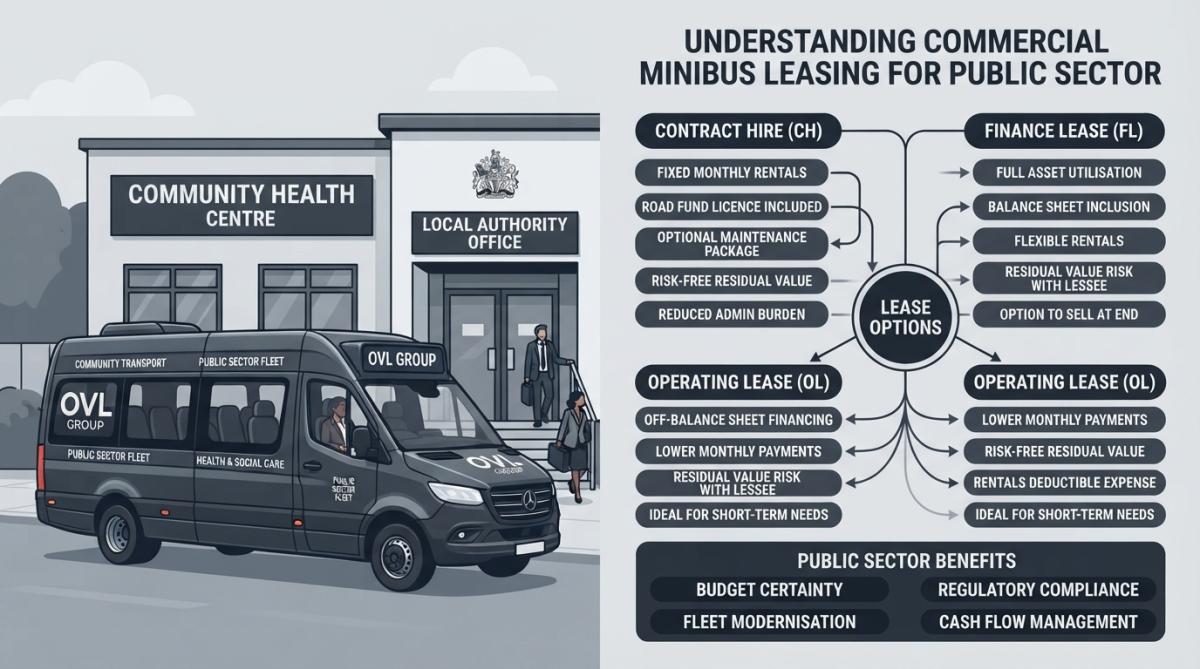
Contract hire is an operational lease where the supplier retains ownership and residual value risk. You pay a fixed monthly rental covering the vehicle, maintenance, and often insurance. Finance lease transfers ownership and residual value risk to you; you own the vehicle at lease end and bear any shortfall if residual value is lower than expected. Contract hire is more common in public sector because it provides cost predictability and removes residual value uncertainty.
How do I ensure my minibus leasing contract complies with public procurement regulations?
Use established frameworks like RM6268 where possible; these pre-qualify suppliers and incorporate compliance requirements. For bespoke procurements, ensure your tender documentation clearly specifies regulatory requirements including PSV certification, emissions compliance, safety standards, and insurance requirements. Work with your procurement team and legal advisors to review contracts before signature.
What happens if I exceed my mileage allowance during the lease?
You'll be charged excess mileage fees, typically 8-15 pence per mile depending on the vehicle and lease terms. Before signing, analyse your actual mileage patterns and build in a buffer to avoid surprises.
Can electric minibuses handle the range requirements of community transport services?
Most modern electric minibuses offer 150-250 miles per charge, which covers the daily requirements of typical community transport operations. However, you need to plan charging infrastructure and consider whether your depot can accommodate overnight charging. For organisations with longer daily routes, you may need to combine electric minibuses with diesel vehicles or install fast-charging facilities.
What training and support do leasing suppliers typically provide for accessible minibus operation?
Quality suppliers include driver training covering passenger assistance, wheelchair securing, emergency procedures, and safeguarding awareness. They should provide ongoing support for compliance documentation and help you maintain training records. Confirm training inclusions in your contract before signing.
How do I manage compliance documentation for a leased minibus fleet?
Your leasing supplier should provide a fleet management system or support structure for tracking maintenance records, safety inspections, driver training, and regulatory compliance. Some suppliers offer integrated systems; others provide documentation templates and checklists. Clarify what compliance support is included in your contract.
What happens if my minibus leasing supplier goes out of business?
This risk is why working with established, financially stable suppliers matters. Larger suppliers typically have contingency arrangements to transfer customer contracts to other operators if they fail. For public sector organisations, this is another reason to use established procurement frameworks; CCS-approved suppliers are subject to financial viability checks.
Can I upgrade vehicles mid-lease if my requirements change?
Most leasing contracts allow vehicle changes, though this typically triggers early termination fees and may require renegotiation of terms. Discuss flexibility provisions before signing. Some suppliers offer more flexible arrangements that allow periodic reviews and adjustments without penalties.
How do I transition from diesel to electric minibuses in my fleet?
Plan a phased transition over 2-3 years, starting with routes where electric vehicles work best (shorter daily distances, established charging infrastructure). Invest in depot charging infrastructure before bringing electric vehicles online. Work with your leasing supplier to coordinate vehicle transitions and ensure you maintain operational capacity throughout the changeover.
What's the typical lifespan of a minibus battery and what happens if it fails during the lease?
Modern minibus batteries typically retain 80-90% capacity after 5 years. Most leasing contracts include battery warranty coverage, meaning the supplier bears the cost of battery replacement or repair during the lease term. Clarify battery coverage explicitly in your contract; this is a critical protection when leasing electric vehicles.
Frequently Asked Questions
What are the key benefits of commercial minibus leasing for public sector organisations?
Leasing minibuses offers public sector organisations significant advantages: predictable budgeting through fixed monthly payments, elimination of capital expenditure, access to modern vehicles meeting current emissions compliance standards, and comprehensive maintenance packages included in contract hire agreements. Leasing also simplifies fleet management through dedicated account management and reduces administrative burden via integrated fleet management systems. This approach allows organisations to focus resources on service delivery rather than vehicle ownership complexities.
How do public sector minibus procurement frameworks like RM6268 work?
The Crown Commercial Service provides standardised procurement frameworks such as RM6268, enabling public sector organisations to access pre-negotiated minibus leasing contracts. These frameworks streamline the tender process and market engagement, reducing procurement timescales and administrative costs. Organisations can access approved suppliers through these frameworks without conducting individual tenders, ensuring compliance with public sector procurement regulations whilst maintaining competitive pricing and service standards across contract hire arrangements.
What regulations and compliance requirements apply to minibus leasing regulations UK for public sector use?
Public sector minibus operations must comply with UK vehicle safety standards, emissions regulations, and HMRC tax requirements for lease arrangements. Operators must ensure vehicles meet current emissions compliance standards and safety specifications. Driver training and duty of care obligations are essential, particularly for services supporting vulnerable populations in care and community sectors. Lease agreements should specify maintenance packages and residual value terms to ensure regulatory compliance throughout the lease duration.
What makes electric minibus leasing attractive for public sector organisations?
Electric minibus leasing for public sector UK applications offers reduced operational expenditure through lower fuel and maintenance costs compared to traditional diesel vehicles. Modern EV minibuses support sustainability targets and emissions compliance objectives. Total cost of ownership analysis often demonstrates financial benefits when considering fuel savings, reduced maintenance requirements, and potential government incentives. However, organisations should evaluate charging infrastructure availability, lease duration flexibility, and residual value considerations before transitioning to EV across their fleet.
[EXTERNAL_LINK: Crown Commercial Service vehicle leasing frameworks guidance | crowncommercial.gov.uk]
[EXTERNAL_LINK: HMRC guidance on salary sacrifice schemes and vehicle benefits | hmrc.gov.uk]
[EXTERNAL_LINK: Department for Transport accessibility standards for public service vehicles | gov.uk]