Table of Contents
- What Are Company Car Leasing Schemes?
- Benefits of Leasing vs. Purchasing for Company Vehicles
- Salary Sacrifice Car Schemes: How They Work
- Understanding Benefit in Kind Tax Rates
- Company Car Allowance vs Lease: Which Suits Your Business?
- Electric Vehicle Company Car Incentives and Benefits
- Fleet Management and Operational Efficiency in Leasing
- Cost Transparency and Total Cost of Ownership
Last Updated: June 2026
Choosing the right company car leasing scheme can save a business thousands of pounds annually, yet many finance and fleet managers default to vehicle ownership without running the numbers. At OVL Group, we work with businesses across the UK to match organisations to the leasing structure that fits their operational and tax position. Below, we break down every major scheme type, tax implications, EV incentives, and total cost of ownership factors that often get overlooked.
Company car leasing schemes span salary sacrifice arrangements, contract hire, lease-purchase agreements, and fleet management contracts, each with different tax treatment, balance sheet implications, and operational flexibility. Getting the structure wrong costs money. Getting it right can make your vehicle fleet a genuine competitive advantage.
What Are Company Car Leasing Schemes?
Company car leasing schemes are structured finance arrangements that allow businesses to access vehicles for a fixed monthly payment over an agreed term, without taking ownership of the asset. Organisations convert capital expenditure into predictable operational expenditure, preserving cash flow for core business activity.
The most common structures in the UK market include:
- Contract hire: The business pays a fixed monthly rental. The leasing company retains ownership and residual risk. VAT-registered businesses can typically reclaim 50% of the VAT on cars and 100% on vans.
- Finance lease: The business uses the vehicle and bears the residual value risk. The asset appears on the balance sheet under IFRS 16.
- Lease-purchase agreement: Structured like hire purchase, with ownership transferring at the end of the term. Treated as capital expenditure.
- Salary sacrifice schemes: Employees exchange gross salary for a company car benefit, reducing income tax and National Insurance for both parties.
The distinction between these structures matters enormously for tax planning, financial reporting, and fleet flexibility.
Benefits of Leasing vs. Purchasing for Company Vehicles
Most businesses that have run a proper whole life cost analysis reach the same conclusion: leasing outperforms outright purchase for the majority of company car use cases.
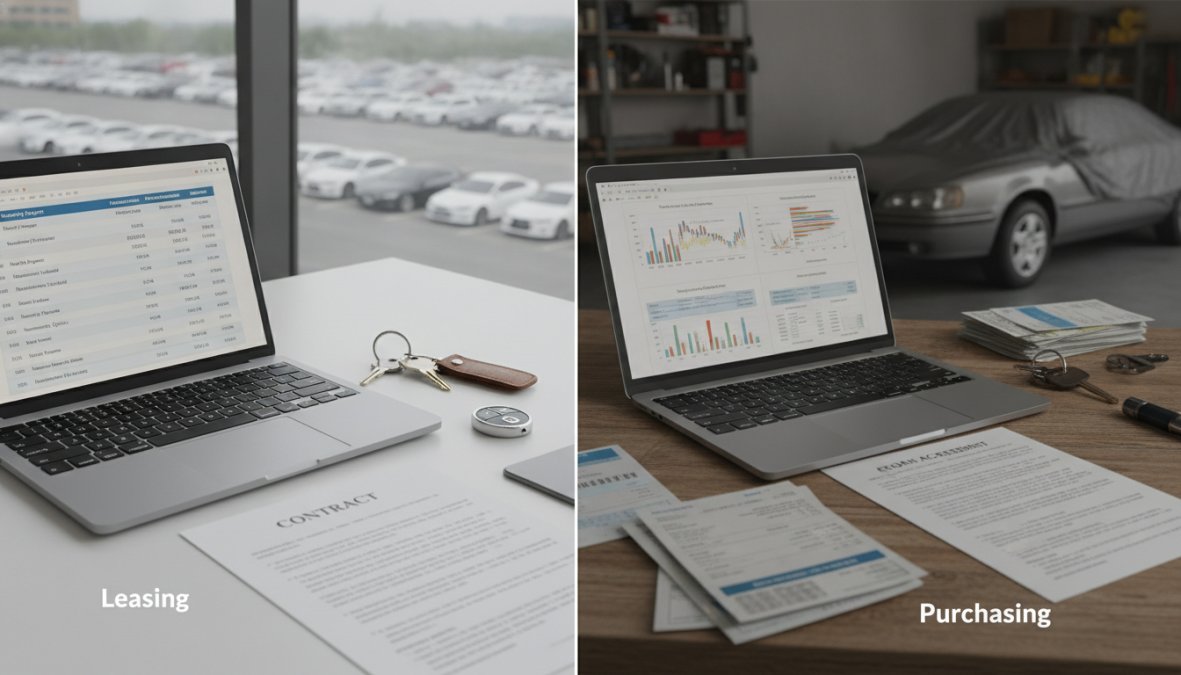
Leasing's core advantage is capital efficiency. Purchasing vehicles ties up significant capital in a depreciating asset. Most company cars lose substantial value in the first three years, with that depreciation sitting entirely on the business's books. With contract hire, the leasing company absorbs the residual value risk.
Beyond depreciation, operational benefits include:
- Predictable monthly costs remove budget volatility from unexpected repair bills
- Fixed service, maintenance and repair (SMR) packages bundled into the monthly rental
- Fleet flexibility to scale vehicle numbers at contract renewal
- No disposal burden at end of term
The case for purchasing is narrowest when vehicles are driven at very high annual mileages or kept beyond typical lease terms. For most businesses operating vehicles on three or four-year cycles, leasing wins on total cost.
According to BVRLA fleet industry data and annual reports, contract hire remains the dominant funding method for UK company cars, reflecting the broad commercial preference for operational expenditure over capital expenditure.
Salary Sacrifice Car Schemes: How They Work
The salary sacrifice car scheme is the most tax-efficient company car leasing structure available to UK employees, particularly for electric vehicles.
Under a salary sacrifice scheme, an employee agrees to reduce their gross salary by an amount equal to the monthly lease cost of their chosen vehicle. The employer then provides the car as a benefit in kind. Because the salary reduction happens before income tax and National Insurance are calculated, both parties pay less.
The employer saves on employer National Insurance contributions on the sacrificed salary. The employee saves income tax and employee NI on that portion of pay. For a basic rate taxpayer driving a fully electric vehicle, the combined saving can make a salary sacrifice arrangement significantly cheaper than a personal lease for the same car.
Key structural points:
- The employer takes on the lease contract and carries the credit risk
- Employees typically choose from a curated vehicle list
- The scheme must comply with HMRC rules on flexible remuneration
- Salary sacrifice reduces pensionable pay unless the employer makes a compensating pension contribution
A common mistake is launching a scheme without modelling the impact on employees approaching minimum wage thresholds. Salary sacrifice cannot reduce pay below the National Living Wage, which creates eligibility limits for lower-paid staff.
Understanding Benefit in Kind Tax Rates
Benefit in kind (BIK) tax rates determine how much income tax an employee pays on a company car. The tax liability varies dramatically depending on the car's CO2 emissions and fuel type.
HMRC sets BIK tax rates as a percentage of the vehicle's P11D value (the list price including options). That percentage is multiplied by the employee's marginal income tax rate to calculate the annual tax charge.
For 2026, fully electric vehicles carry a BIK rate of just 3%. A conventionally fuelled car emitting over 170g/km CO2 can attract a rate above 37%. The difference in annual tax cost between an EV and a high-emission vehicle can run to several thousand pounds per year for a higher-rate taxpayer.
Vehicle Type | Approximate CO2 (g/km) | 2026 BIK Rate |
|---|---|---|
Fully electric | 0 | 3% |
Plug-in hybrid (up to 50g/km) | 1-50 | 5-14% (varies by electric range) |
Petrol/diesel (low emission) | 51-100 | 17-21% |
Petrol/diesel (medium emission) | 101-150 | 22-30% |
Petrol/diesel (high emission) | 151g/km+ | 31-37%+ |
As documented in HMRC company car tax tables and guidance, the P11D value and emissions figure are the two variables that most directly control an employee's annual tax liability.
Company Car Allowance vs Lease: Which Suits Your Business?
The company car allowance vs lease decision is one of the most consequential choices a fleet manager makes.
A company car allowance pays a cash sum to the employee, who sources and funds their own vehicle privately. The allowance is added to gross salary and taxed accordingly. The employee bears all risk: depreciation, maintenance, insurance, and disposal. The employer simplifies fleet administration but loses control over vehicle standards.
A company car lease gives the employer control over vehicle specification, safety standards, and emissions profile. The employer manages the contract and carries the financial relationship with the leasing company.
The practical trade-offs:
- Allowances suit mobile workers who prefer personal choice
- Leasing suits organisations needing consistent vehicle standards, duty of care compliance, or fleet-level emissions reporting
- Allowances create grey fleet risk: employees driving older, potentially unsafe private vehicles on company business
- Leasing creates a cleaner audit trail for insurance and health and safety
According to HSE guidance on managing work-related road risk, employers have a legal duty of care for employees driving on company business, regardless of vehicle ownership. A cash allowance does not remove that obligation.
For businesses with strong sustainability commitments or managing ten or more vehicles, a structured leasing approach delivers better outcomes than a pure allowance model.
Electric Vehicle Company Car Incentives and Benefits
Electric vehicles are the most compelling argument for reviewing your company car leasing schemes right now. The combination of low BIK rates, favourable first-year capital allowances for employers, and falling lease costs makes EVs the most tax-efficient company car choice available in 2026.
For employers, 100% first-year allowances apply to zero-emission cars purchased outright, meaning the full cost offsets taxable profit in year one. For leased EVs, monthly payments are treated as a business expense.
For employees, the 3% BIK rate on fully electric vehicles creates a monthly tax cost that is a fraction of what an equivalent petrol car would attract. On a mid-range electric saloon with a P11D value of £40,000, a higher-rate taxpayer pays approximately £480 per year in BIK tax. The same calculation on a comparable petrol car at a 30% BIK rate would exceed £4,800 annually.
Practical EV adoption considerations:
- Charging infrastructure: Employers can provide workplace charging free of a BIK charge
- Home charging: HMRC's electric vehicle home charge scheme allows tax-efficient charger installation funding
- Range anxiety: Modern EVs cover the majority of UK business journeys on a single charge
- Lease cost trends: EV lease rates have become increasingly competitive as manufacturer supply has grown
For businesses exploring EV adoption, Electric / Hybrid Leasing provides dedicated support in transitioning your fleet, and those seeking to reduce upfront costs can explore Lease Used Electric Vehicles as a cost-effective alternative.
Fleet Management and Operational Efficiency in Leasing
Operational efficiency is where leasing schemes pay dividends beyond the headline monthly cost. A well-structured fleet management arrangement removes the administrative burden that makes running a company vehicle fleet difficult.
Core operational advantages of managed leasing:
- Centralised contract management across all vehicles, with renewal dates tracked proactively
- Consolidated SMR programmes that negotiate volume rates with service providers
- Driver management tools that track licence checks, mileage, and fuel card usage
- Mileage restriction management to avoid excess mileage penalties at contract end
- Asset utilisation reporting to identify underused vehicles
Many businesses pay for vehicles driven fewer than 8,000 miles per year, well below the threshold where lease cost represents good value. Regular asset utilisation reviews can identify these vehicles and either reallocate them or remove them at the next renewal.
Cost Transparency and Total Cost of Ownership
The biggest mistake in evaluating company car leasing schemes is comparing monthly rentals without accounting for total cost of ownership (TCO). A lower monthly rental can easily be outweighed by higher fuel costs, SMR exposure, or unfavourable end-of-lease conditions.
A genuine TCO analysis should include:
Cost Component | What to Include | Common Oversight |
|---|---|---|
Finance cost | Monthly rental, deposit, admin fees | Forgetting admin and documentation fees |
Fuel / energy | Fuel card costs, home charging, MPG | Using manufacturer figures rather than real-world |
SMR | Service, maintenance, tyres, MOT | Excluding tyre costs from maintenance packages |
Insurance | Fleet policy premium per vehicle | Failing to model younger driver surcharges |
BIK tax | Employee annual tax liability | Calculating on list price rather than P11D |
Excess mileage | Pence per mile penalty above contract | Underestimating annual mileage at contract start |
End-of-lease | Fair wear and tear charges | Not briefing drivers on BVRLA standards |
The BVRLA's fair wear and tear guide is the industry standard for assessing vehicle condition at lease return. As detailed in BVRLA fair wear and tear standards for cars, vehicles returned outside these standards attract charges that can run to hundreds of pounds per vehicle if driver briefing has been inadequate.
OVL Group's whole life cost analysis covers every line in the table above, producing a single comparable monthly figure that allows genuine apples-to-apples comparison between vehicle options, fuel types, and leasing structures. We also offer [Vehicle Leasing Special Offers](https://www.ovl.co.uk/special-offers) and Van Leasing Special Offers to help businesses optimise their fleet investment.
The businesses that get the most from company car leasing schemes are the ones that treat fleet decisions as financial decisions, not just vehicle decisions. Structure, tax, total cost, and operational efficiency are all levers. Pull the right ones and the savings are substantial.
Managing a company vehicle fleet involves multiple moving parts, from BIK tax planning and salary sacrifice administration to end-of-lease condition management and EV transition strategy. OVL Group provides tailored vehicle leasing solutions backed by whole life cost analysis, dedicated account management, and the FleetManagerPlus system to keep fleet administration under control. Get started with OVL Group and build a leasing strategy that cuts costs, reduces tax exposure, and positions your fleet for the shift to electric.
Frequently Asked Questions
How do company car leasing schemes work?
Company car leasing schemes allow businesses to lease vehicles for employees rather than purchasing them outright. The employer enters a lease agreement with a provider, typically covering maintenance, servicing, and insurance through a turnkey solution. Employees receive the vehicle as a taxable benefit, with the employer paying monthly lease costs. This approach provides fleet flexibility, simplifies asset utilization, and removes the burden of vehicle disposal at end-of-life. It's particularly effective for organisations managing multiple vehicles across their workforce.
What are the tax implications of a salary sacrifice car scheme?
Under a salary sacrifice car scheme, employees sacrifice part of their gross salary in exchange for a company car. This reduces their taxable income, lowering both income tax and National Insurance contributions. However, employees pay benefit in kind tax on the car's value. The tax is calculated based on the vehicle's list price and CO₂ emissions. Electric vehicles attract lower benefit in kind tax rates—currently 2%—making them increasingly attractive. Employers also benefit from reduced National Insurance contributions on the sacrificed salary amount.
Is it better to offer a company car allowance or a company car lease?
A company car lease provides greater cost control, as monthly payments are fixed and predictable. It includes maintenance and servicing, reducing operational surprises. A cash allowance gives employees flexibility to choose their own vehicle but creates variable costs and tax complexity. Leasing typically offers better compliance management and ensures consistent fleet standards. For organisations prioritising fiscal accountability and budgetary constraints, leasing provides clearer cost transparency. The choice depends on your workforce preferences, tax efficiency goals, and operational requirements.
What are the main benefits of electric vehicles in company car schemes?
Electric vehicles offer significant tax advantages in company car schemes. They attract the lowest benefit in kind tax rates at 2%, substantially reducing employee tax liability compared to petrol or diesel vehicles. EVs also deliver lower operational costs through reduced fuel and maintenance expenses. Many organisations use EV technology to support sustainability commitments whilst improving employee satisfaction. Additionally, electric vehicle company car incentives—including potential government support—can reduce overall lease costs. They're particularly suitable for businesses with defined route patterns and charging infrastructure.