Table of Contents
- What Fleet Leasing Companies in the UK Offer
- Contract Hire vs Finance Lease: Understanding Your Options
- Benefits of Fleet Leasing for Small Businesses
- Electric Vehicle Fleet Leasing UK: The Green Transition
- Key Features to Compare Across Fleet Leasing Companies
- Total Cost of Ownership: Leasing vs Buying
- How to Choose the Right Fleet Leasing Partner
- Conclusion
Last Updated: June 2026
Choosing between fleet leasing companies UK is one of the most consequential decisions a business can make for its operational costs, tax position, and long-term growth. The wrong choice locks you into years of inflated costs and poor support. The right one reduces overheads, simplifies administration, and keeps your drivers on the road. Below, we'll show you exactly what separates a strong fleet leasing partner from a mediocre one.
Fleet leasing is not just a procurement exercise, it's a financial and operational strategy. Contract hire, finance lease, salary sacrifice, and total cost of ownership analysis are interconnected decisions that compound over a fleet's lifetime. Get the structure wrong at the start and you'll pay for it across every renewal cycle.
What Fleet Leasing Companies in the UK Offer
Fleet leasing is a funding and management arrangement in which a business contracts vehicles from a specialist provider, paying fixed monthly rentals over an agreed term rather than purchasing assets outright. The best fleet leasing companies UK offer far more than a list of cars and a monthly invoice. Full-service providers bundle vehicle procurement, maintenance packages, telematics, compliance tracking, driver support, and end-of-contract vehicle disposal into a single managed service.
Full-Service Fleet Management Services
Full-service fleet management covers the entire vehicle lifecycle: from initial specification and ordering through to servicing, tyres, breakdown cover, and final disposal. Businesses that choose this route trade variable, unpredictable maintenance costs for a fixed monthly budget line.
Key components typically include scheduled servicing and MOT management, tyre replacement, breakdown and recovery cover, fleet compliance and licence checking, driver risk profiling, and accident management. OVL Group's whole life cost analysis covers finance, fuel, SMR (service, maintenance and repair), insurance, and tax together, rather than treating them as separate line items.
Vehicle Procurement and Contract Hire Explained
Contract hire is an operational lease agreement in which a business hires a vehicle for a fixed term and mileage, with the leasing company retaining ownership and residual value risk. Monthly rentals are calculated based on the vehicle's predicted depreciation over the contract period.
Vehicle procurement under a managed fleet arrangement means the leasing company handles manufacturer negotiations, delivery logistics, and fleet specification. For businesses running more than a handful of vehicles, this generates meaningful savings through volume purchasing power. According to BVRLA fleet industry data and guidance, contract hire remains the most popular fleet funding method in the UK.
Contract Hire vs Finance Lease: Understanding Your Options
The choice between contract hire and finance lease comes down to your business's tax position, balance sheet requirements, and appetite for residual value risk.
How Contract Hire Works
Contract hire is an operating lease. The leasing company owns the vehicle throughout the contract, sets a residual value, and you pay a fixed monthly rental for use. At contract end, you return the vehicle. The leasing company absorbs any shortfall if the vehicle's market value falls below the residual value assumption.
For VAT-registered businesses, 50% of the VAT on the monthly rental is recoverable for cars (100% if used exclusively for business). For vans, full VAT recovery is available.
How Finance Lease Differs
A finance lease gives you more control but more risk. You take on the residual value risk. At contract end, you can sell the vehicle, and any proceeds above the agreed residual value are shared with the funder, while any shortfall is your liability. Finance lease is often preferred by businesses that want to keep vehicles longer than a standard contract hire term.
Feature | Contract Hire | Finance Lease |
|---|---|---|
Ownership | Leasing company | Leasing company (legal) |
Residual value risk | Leasing company | Business |
Balance sheet treatment | Off-balance sheet | On-balance sheet |
VAT recovery (cars) | 50% | 50% |
End-of-contract options | Return vehicle | Sell or extend |
Best for | Predictable budgeting | Flexible end-of-life control |
Maintenance packages | Often included | Usually separate |
Benefits of Fleet Leasing for Small Businesses
Small businesses running between three and twenty vehicles face different financial logic than larger fleets. Fleet leasing offers particular advantages at this scale.
Cost Predictability and Budgeting
The single most practical benefit of fleet leasing for small businesses is fixed monthly costs. A single monthly rental covering depreciation, road fund licence, and optionally maintenance means finance teams can budget twelve months ahead without surprises. For SME fleets, this predictability often outweighs the total cost comparison with outright purchase, as cash flow is the lifeblood of a small business. Many providers offer Vehicle Leasing Special Offers and [Van Leasing Special Offers](https://www.ovl.co.uk/van-leasing/special-offers) that can further improve budget efficiency for qualifying fleets.
Tax Efficiency and BIK Considerations
BIK (Benefit in Kind) tax is the tax charge applied to employees who use company vehicles for private use. It's calculated as a percentage of the vehicle's list price, with the percentage determined by CO2 emissions.
Electric vehicles currently attract a BIK rate of just 2%, compared to rates that can reach 37% for high-emission vehicles. For a director driving a £50,000 car, the difference in annual tax liability between an EV and a high-emission vehicle runs to several thousand pounds per year. Salary sacrifice schemes are particularly tax-efficient when structured around low-emission vehicles.
As documented in HMRC guidance on company car tax and BIK, the BIK rate for zero-emission vehicles is confirmed at 2% through to the 2027-28 tax year.
Electric Vehicle Fleet Leasing UK: The Green Transition
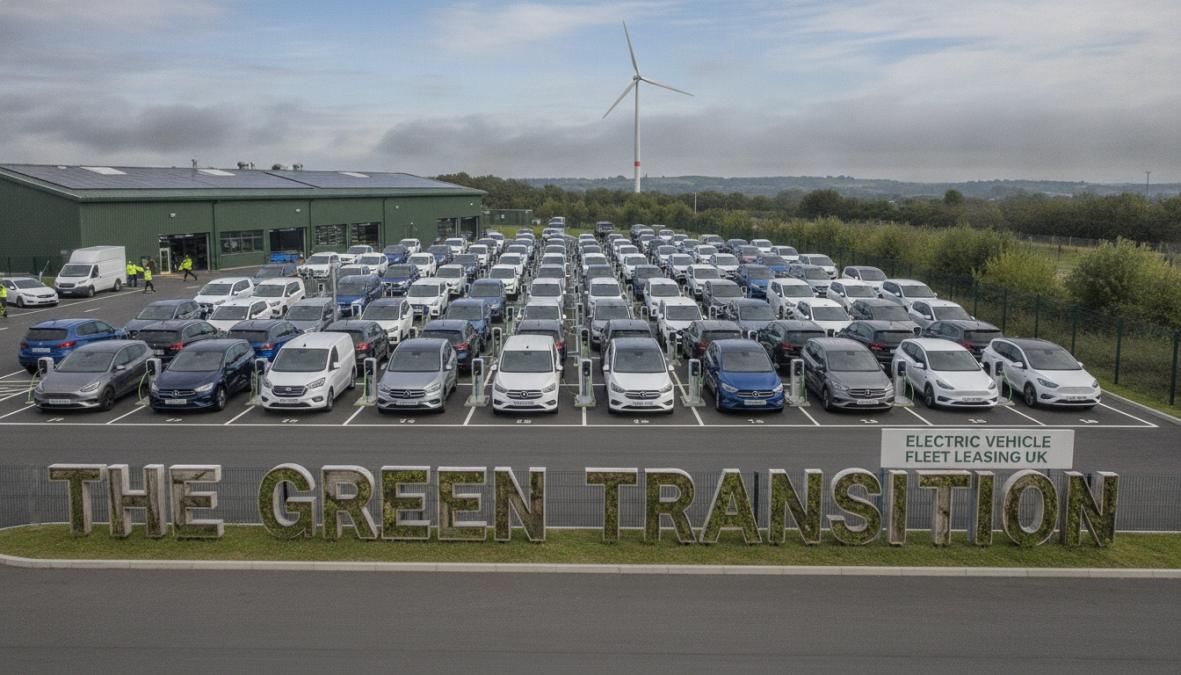
Electric vehicle fleet leasing UK is no longer niche. For many businesses, transitioning to EVs is now the financially rational choice. The combination of low BIK rates, reduced fuel costs, and improving vehicle range has shifted the total cost of ownership calculation decisively in favour of EVs for many fleet applications.
EV Charging Infrastructure Integration
The charging infrastructure decision is as important as the vehicle decision. A fleet of EVs without a coherent charging strategy creates operational disruption that quickly erodes financial benefits.
The practical approach breaks down into three tiers: home charging (most cost-effective for drivers who return home each evening, with OZEV grants available), depot charging (essential for vans and commercial vehicles), and public charging networks (necessary for long-distance drivers). Electric / Hybrid Leasing and Lease Used Electric Vehicles services address the whole picture, not just the vehicle contract, helping businesses navigate both new and used EV options.
Sustainability Reporting for Fleets
Fleet emissions are increasingly material to corporate sustainability reporting. For businesses subject to simplified Energy and Carbon Reporting (SECR) requirements or responding to customer ESG questionnaires, fleet CO2 data is a core input.
A well-structured fleet leasing arrangement should provide granular emissions data by vehicle, driver, and business unit. The transition to EVs directly reduces Scope 1 emissions and, depending on electricity source, Scope 2 emissions. For businesses with net-zero commitments, fleet electrification is typically one of the highest-impact interventions available.
Key Features to Compare Across Fleet Leasing Companies
Not all fleet leasing companies UK operate at the same standard. The gap between a good and a poor provider shows up in account management quality, technology capability, and maintenance network depth.
Fleet Size and Capacity Options
The right fleet leasing partner for a three-vehicle SME fleet is not necessarily the right partner for a 300-vehicle corporate fleet. Ask prospective providers: what proportion of your client base runs a fleet of our size? A provider whose average client runs 200 vehicles will not prioritise a 10-vehicle account in the same way a specialist SME fleet partner will.
Maintenance Packages and Vehicle Support
Maintenance packages vary significantly in scope. A basic package covers scheduled servicing and MOT. A comprehensive package adds tyres, glass, accident management, and breakdown cover. For van-heavy fleets, tyre management is particularly significant, as vans cover higher mileages and carry heavier loads.
Telematics, Compliance and Driver Support
Telematics systems track vehicle location, driver behaviour, fuel consumption, and mileage. For fleet managers, the data outputs support duty of care compliance, identify fuel-saving opportunities, and provide evidence in accidents or insurance disputes.
Compliance management automates licence checking, vehicle roadworthiness records, and driver risk assessments. OVL Group's FleetManagerPlus system brings fleet administration, compliance tracking, and reporting into a single platform, reducing manual processes.
Total Cost of Ownership: Leasing vs Buying
Total cost of ownership (TCO) analysis is the correct framework for comparing leasing against outright purchase. Monthly rental figures alone are not a fair comparison point.
Cost Element | Leasing | Outright Purchase |
|---|---|---|
Capital outlay | None (monthly rental) | Full purchase price |
Depreciation risk | Leasing company | Business |
Maintenance costs | Fixed (if included) | Variable |
Residual value benefit | None | Business retains |
Interest/finance cost | Built into rental | Opportunity cost of capital |
Administration burden | Low (managed service) | High (internal management) |
Tax treatment | Rental deductible | Capital allowances |
Flexibility | Contract term limits | Can sell at any time |
Many businesses assume outright purchase is cheaper because they avoid the leasing company's margin. This misses the opportunity cost of capital, the cost of internal fleet management time, and exposure to residual value risk. For most SME fleets, a properly structured contract hire arrangement compares favourably on total cost. The TCO calculation shifts further in favour of leasing for EV fleets, where battery technology is still evolving and residual value uncertainty is higher.
How to Choose the Right Fleet Leasing Partner
The market for fleet leasing companies UK is crowded. The right framework makes the decision straightforward.
Assessing Your Operational Needs
Start with a clear brief before approaching any provider. Document your current fleet size, vehicle types, average annual mileage, driver profile, and any specific operational requirements. The most common mistake is approaching providers without a defined mileage assumption. Contract hire rentals are highly sensitive to contracted mileage, and excess mileage charges at contract end can be significant.
Evaluating Account Management and Support
Account management quality is the most underrated factor in fleet leasing partner selection. A dedicated account manager who understands your business, responds promptly, and proactively flags cost-saving opportunities is worth more than a marginally lower monthly rental.
Ask prospective providers: who will manage my account day-to-day? What is the escalation process if there is a problem? What is the average fleet size managed by each account manager? According to Chartered Institute of Procurement and Supply guidance on supplier relationship management, the quality of the ongoing relationship with a service provider is consistently cited as a primary driver of value in long-term contracts.
Selecting the right fleet leasing partner affects costs, compliance, and driver satisfaction for years. OVL Group brings together whole life cost analysis, dedicated account management, and specialist expertise across cars, electric vehicles, vans, and minibuses. Whether you need a salary sacrifice scheme, a full-service contract hire arrangement, or strategic EV transition planning, the OVL Group team is ready to build a solution around your specific operational needs.
Frequently Asked Questions
What is the difference between contract hire and finance lease?
Contract hire is a fully managed service where you pay a fixed monthly fee covering maintenance, insurance, and servicing. The leasing company retains ownership and handles vehicle disposal. Finance lease is a funding arrangement where you own the vehicle at lease end and cover maintenance separately. Contract hire suits businesses wanting predictable costs and minimal administration, while finance lease appeals to those seeking eventual ownership and greater control over vehicle maintenance.
How do fleet leasing companies help small businesses reduce operational costs?
Fleet leasing companies offer cost predictability through fixed monthly payments, eliminating unexpected repair bills and depreciation concerns. They provide whole-life cost analysis covering finance, fuel, maintenance, insurance, and tax, helping SMEs budget accurately. Many offer salary sacrifice schemes for employees, reducing taxable income. By outsourcing fleet management to specialists, small businesses avoid capital expenditure on vehicles and free up cash flow for growth initiatives whilst benefiting from expert procurement and negotiation power.
What tax benefits are available through fleet leasing in the UK?
Fleet leasing offers several tax advantages. Contract hire payments are typically tax-deductible as a business expense, reducing corporation tax liability. Salary sacrifice schemes allow employees to sacrifice salary for vehicle benefits, lowering both employee income tax and employer National Insurance contributions. Electric vehicle leasing offers enhanced capital allowances and reduced Benefit-in-Kind (BIK) tax rates for employees. Directors and employees should seek professional advice, as tax treatment varies by lease structure, vehicle type, and individual circumstances.
Why should businesses consider electric vehicle fleet leasing?
EV fleet leasing supports the green transition whilst managing cost and infrastructure challenges. Leasing companies provide access to the latest EV technology without long-term ownership risk, handle charging infrastructure integration planning, and offer sustainability reporting to track carbon reduction progress. EV salary sacrifice schemes offer significant tax savings, and lower fuel and maintenance costs offset higher vehicle prices. Fleet leasing specialists guide EV adoption strategy, ensuring your business meets environmental targets whilst maintaining operational efficiency and cost control.