Table of Contents
- Understanding Fleet Planning Strategies for Growing Companies
- Vehicle Acquisition Strategies for Fleets
- Cost-Effective Fleet Growth Without Compromising Operations
- Fleet Management Software for Growing Businesses
- Optimizing Fleet Operations for Scalability
- Risk Mitigation and Compliance in Fleet Expansion
- Implementing Your Fleet Planning Strategy: A Practical Roadmap
- Conclusion
Fleet Planning Strategies for Growing Companies
Last Updated: July 22, 2026
Fleet planning strategies for growing companies are often overlooked drivers of operational efficiency and profitability. Most expanding businesses add vehicles reactively without considering total cost of ownership, regulatory compliance, or long-term scalability. Companies investing in structured fleet planning see measurable improvements in cost control, staff retention, and customer service delivery within 12 months.
This guide breaks down the essential framework for building a fleet that grows with your business.
Understanding Fleet Planning Strategies for Growing Companies
Fleet planning for growing companies requires anticipating demand shifts, managing cash flow constraints, maintaining regulatory compliance, and ensuring operational infrastructure scales without breaking down. The core tension is this: rapid growth demands agility, but poorly planned expansion creates debt, operational chaos, and tax inefficiency.
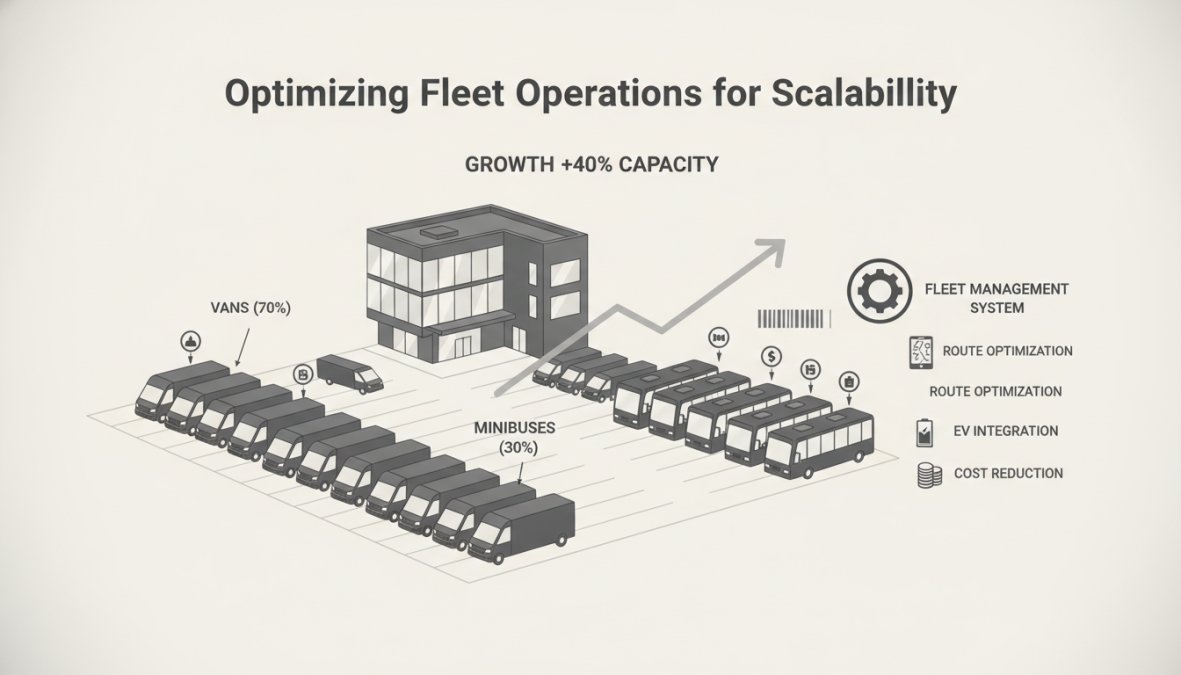
What separates successful fleet expansion from chaotic growth comes down to three factors: understanding your true vehicle requirements before purchasing, choosing the right financing model for your growth stage, and building systems that scale without requiring proportional administrative overhead.
Vehicle Acquisition Strategies for Fleets
The decision between purchasing, leasing, or a hybrid approach fundamentally shapes your fleet's financial performance and operational flexibility.
Leasing vs. Purchasing: A Total Cost of Ownership Approach
Most finance directors evaluate vehicle costs on monthly payment alone, missing the true expense. A £25,000 purchase price looks cheaper than a £450/month lease until you factor in maintenance, repairs, insurance, fuel efficiency changes, and residual value risk.
Total cost of ownership (TCO) analysis reveals the true expense over a vehicle's useful life. A van purchased for £35,000 with a five-year lifespan costs significantly more than the headline price: servicing and maintenance (£2,000-£3,000 annually), insurance (£1,200-£1,800 per year), fuel inefficiency as the vehicle ages, and potential breakdown costs. By year three, repair costs spike sharply. A leased alternative at £400-£500 monthly includes most servicing, maintains fuel efficiency standards, and removes residual value risk.
For fleets under 20 vehicles, leasing provides superior flexibility to adjust composition as your business model evolves. For larger fleets (50+ vehicles), a mixed approach, leasing core operational vehicles and purchasing specialised equipment, often delivers the best TCO outcome. Many growing companies also explore Vehicle Leasing Special Offers and Van Leasing Special Offers to optimise their acquisition costs during expansion phases.
Electric and Hybrid Vehicles in Your Growth Plan
The shift toward electric and hybrid vehicles is an immediate strategic decision for growing fleets. HMRC regulations increasingly favour zero-emission vehicles through enhanced capital allowances and salary sacrifice schemes, making electric vehicle adoption both environmentally responsible and financially advantageous.
An electric van costs more upfront but delivers 70-80% lower fuel costs than diesel equivalents. Over a five-year lease, this translates to meaningful savings for urban logistics, care home transport, and field service operations with predictable daily mileage.
Before committing to EV fleet expansion, audit your depot facilities for charging infrastructure. For companies with fixed routes and predictable daily mileage under 150 miles, EVs eliminate range anxiety entirely. For long-distance or unpredictable routing, hybrid vehicles provide a practical middle ground. Growing companies exploring electric vehicle options can review Electric / Hybrid Leasing and [Lease Used Electric Vehicles](https://www.ovl.co.uk/used-evs) to understand the full range of zero-emission options available.
UK Government electric vehicle grant schemes and tax incentives support fleet transition toward zero-emission vehicles, making this an opportune moment for growing companies to shift their acquisition strategy.
Cost-Effective Fleet Growth Without Compromising Operations
Scaling your fleet without proportional cost increases requires discipline around capital efficiency, maintenance planning, and administrative automation.
Whole Life Cost Analysis for Sustainable Expansion
Whole life cost analysis incorporates fuel consumption patterns, driver behaviour impacts, maintenance scheduling, insurance risk profiles, and residual value projections across your entire fleet cohort. For growing companies, this reveals hidden cost drivers.
A fleet of mixed vehicle ages and specifications creates complexity: different spare parts inventory, varied driver training requirements, inconsistent fuel consumption patterns, and unpredictable maintenance scheduling. Standardising your fleet toward consistent vehicle types and ages reduces administrative burden and improves cost predictability.
A practical example: Company A expanded from 15 to 40 vans by purchasing used vehicles opportunistically. By year three, maintenance costs tripled managing five different vehicle models with different service schedules and spare parts requirements. Company B expanded the same volume through structured leasing, maintaining consistent fleet composition and reducing maintenance overhead by 40%.
In-House vs. Outsourced Transport: Cost-Benefit Analysis
Growing companies often decide whether to operate their own fleet or outsource transport to specialist providers. In-house operation provides control and direct cost visibility but requires investment in driver recruitment, training, compliance management, vehicle maintenance infrastructure, and fleet management systems.
Outsourced transport transfers operational complexity and capital requirements to third parties, suiting companies with variable transport needs or where transport isn't a core differentiator. The trade-off is reduced cost control and dependency on external providers.
The break-even analysis depends on utilisation rate. If your fleet operates at 70%+ utilisation, in-house operation typically costs less per mile. Below 50% utilisation, outsourced transport usually delivers better economics. For growing companies, a hybrid model often works best: operate core transport in-house (where you have control and high utilisation) and outsource overflow capacity and specialist requirements.
Fleet Management Software for Growing Businesses
Operational complexity of fleet expansion makes software investment non-negotiable. Without digital systems, you lose visibility into vehicle location, driver behaviour, maintenance scheduling, fuel consumption, and compliance status.
Digital Booking and Tracking Workflows
Digital booking systems provide real-time visibility into vehicle availability, enable drivers to check vehicle status before departure, and automatically log mileage and journey details for compliance and billing. For care home transport, domiciliary care logistics, or field service operations, digital booking eliminates scheduling conflicts, reduces vehicle idle time, and improves response times.
Real-time tracking provides operational oversight. You know where each vehicle is, how fast it's travelling, whether drivers are taking breaks (important for working time regulation compliance), and can respond to breakdowns immediately. This visibility also improves safety by identifying aggressive driving patterns.
Growing companies report 25-30% reductions in administrative overhead and improved driver retention through reduced scheduling stress and better route planning.
Compliance and Administrative Efficiency
Fleet growth multiplies compliance obligations: tracking driver hours under working time regulations, maintaining vehicle maintenance records, ensuring insurance coverage, managing MOT scheduling, and documenting safety training. Digital fleet management systems automate these workflows, triggering maintenance schedules automatically and logging driver hours electronically to prevent accidental breaches.
For growing companies, this automation is essential. A 40-vehicle fleet requires tracking hundreds of compliance deadlines across multiple regulatory frameworks. Manual systems inevitably fail when you're busiest.
HMRC guidance on fleet vehicle tax and [salary sacrifice schemes(/our-services/ovl-salary-sacrifice) | hmrc.gov.uk] sets out the regulatory framework for fleet operations in the UK. Digital systems ensure your company stays compliant while minimising tax liability.
Optimising Fleet Operations for Scalability
Expansion creates operational bottlenecks. Your existing depot might not accommodate additional vehicles. Your current maintenance provider might lack capacity. Your fuel supplier contract might not cover expanded volumes at competitive rates.
Regional Expansion and Multi-Site Coordination
Growing beyond a single location introduces coordination complexity. Successful regional expansion requires standardised processes across all sites. Vehicle specifications should remain consistent, maintenance providers should operate to the same service standards, and fuel procurement should be coordinated centrally.
Multi-site fleet management demands centralised visibility. A digital fleet management system provides headquarters oversight across all regional operations, enabling consistent policy enforcement, standardised safety standards, and centralised procurement.
For companies expanding into new regions, pilot your operational model with a single depot before scaling. Test your maintenance processes, driver recruitment and training approach, fuel procurement strategy, and compliance workflows.
Maintenance Planning and Vehicle Lifecycle Management
Preventive maintenance is cheaper than emergency repairs. Each vehicle follows a predictable maintenance trajectory: minimal costs in years 1-2, rising costs in years 3-5, and sharp cost spikes beyond five years. Effective fleet management requires phasing out vehicles before they reach the high-cost phase.
For growing companies, plan your fleet composition for the maintenance cost trajectory you'll face in 2-3 years. A 20-vehicle fleet expanding to 50 vehicles will experience dramatically higher maintenance costs without deliberate vehicle age distribution management.
Structured maintenance planning also improves safety by catching developing issues before they cause breakdowns or accidents.
Risk Mitigation and Compliance in Fleet Expansion
Rapid growth creates risk through new driver hiring, unfamiliar geographic markets, complex logistics, and higher liability exposure. Proactive risk management prevents costly incidents and regulatory penalties.
HMRC Regulations and Tax-Efficient Salary Sacrifice Schemes
HMRC regulations governing fleet vehicles and salary sacrifice schemes create both compliance obligations and cost-saving opportunities. Salary sacrifice schemes allow employees to lease vehicles through pre-tax salary deductions, reducing both employee tax liability and employer National Insurance contributions.
For growing companies, salary sacrifice schemes improve recruitment and retention by offering employees access to new vehicles at tax-efficient rates. Employees benefit from 20-40% cost savings. Employers benefit from reduced National Insurance contributions (typically 8-10% of vehicle cost).
However, salary sacrifice schemes require meticulous HMRC compliance. You must maintain detailed records of all participants, calculate tax and National Insurance correctly, and ensure vehicles meet HMRC's definition of "company vehicles."
Emergency Contingency Planning for Operational Continuity
Fleet breakdowns create operational crises. Growing companies must plan for contingencies before they occur. Effective contingency planning includes: maintaining relationships with backup vehicle suppliers or rental companies, ensuring insurance covers hire vehicle costs during repairs, documenting alternative routing options, and training staff on escalation procedures.
For companies operating care home transport or emergency services, contingency planning is non-negotiable. You cannot cancel transport because a vehicle has broken down; you must have alternative capacity available. This might mean maintaining reserve vehicles, establishing partnerships with local transport providers, or investing in rapid-repair agreements.
Digital fleet management systems support contingency planning by providing real-time visibility into vehicle status and automatically logging incidents for post-incident analysis.
Implementing Your Fleet Planning Strategy: A Practical Roadmap
Stage 1: Audit Your Current Fleet (Weeks 1-2)
Document every vehicle: age, mileage, maintenance history, fuel consumption, and operating costs. Calculate the fully-loaded cost per vehicle per month. Identify which vehicles perform efficiently and which create cost problems.
Stage 2: Define Your Growth Trajectory (Weeks 3-4)
Project your vehicle requirements over 3-5 years based on business growth forecasts. Build scenarios for accelerated or slowed growth. Your fleet plan should remain viable across realistic growth ranges.
Stage 3: Evaluate Acquisition Models (Weeks 5-6)
Compare leasing, purchasing, and hybrid approaches using whole life cost analysis. Calculate the true cost of each model across your projected growth trajectory. Select the approach that minimises total cost while preserving operational flexibility.
Stage 4: Design Your Fleet Composition (Weeks 7-8)
Specify the vehicle types, sizes, and features required. Standardise where possible. Specify fuel type based on utilisation patterns and total cost of ownership analysis.
Stage 5: Implement Fleet Management Systems (Weeks 9-12)
Select and deploy digital fleet management software prioritising booking, tracking, maintenance scheduling, and compliance reporting. Ensure your team receives proper training.
Stage 6: Establish Governance and Monitoring (Ongoing)
Assign clear ownership for fleet decisions. Establish monthly reporting on key metrics: cost per vehicle per month, fuel consumption, maintenance costs, utilisation rates, and safety incidents.
| Implementation Stage | Timeline | Key Deliverables | Responsibility |
|---|---|---|---|
| Fleet Audit | Weeks 1-2 | Current fleet inventory, cost analysis | Finance / Operations |
| Growth Projection | Weeks 3-4 | 3-5 year vehicle requirement forecast | Operations / Strategy |
| Acquisition Evaluation | Weeks 5-6 | Total cost of ownership comparison, financing recommendation | Finance / Procurement |
| Fleet Composition Design | Weeks 7-8 | Vehicle specifications, standardisation plan | Operations / Procurement |
| System Implementation | Weeks 9-12 | Fleet management software deployed, staff trained | IT / Operations |
| Governance Setup | Ongoing | Monthly reporting, decision frameworks, performance monitoring | Finance / Operations |
Conclusion
Fleet planning strategies for growing companies demand strategic thinking, disciplined execution, and continuous monitoring. Businesses that succeed treat fleet expansion as a business investment, measuring returns through cost control, improved service delivery, and operational reliability.
The challenge isn't complexity; it's consistency. Growing companies that establish clear fleet planning processes, invest in digital systems, and monitor performance metrics see measurable improvements in profitability and operational stability within 12 months.
OVL Group specialises in helping growing companies optimise their fleet through comprehensive whole life cost analysis, salary sacrifice scheme administration, and integrated fleet management systems. Our team provides strategic guidance on vehicle acquisition, financing options, and operational workflows, helping you build a fleet that supports sustainable growth. Get started with OVL Group and transform your fleet into a strategic advantage.
Frequently Asked Questions
What are the key components of effective fleet planning strategies for growing companies?
Effective fleet planning strategies combine vehicle acquisition decisions, cost analysis, technology infrastructure, and scalability frameworks. Growing companies must assess total cost of ownership (including finance, fuel, maintenance, insurance, and tax), choose between leasing and purchasing, evaluate electric vehicle adoption, implement digital management systems, and establish compliance protocols with HMRC regulations. These components work together to support expansion whilst controlling operational costs and managing risk.
How does fleet management software for growing businesses reduce administrative burden?
Fleet management software streamlines operations through digital booking and tracking workflows, automated maintenance scheduling, compliance documentation, and real-time vehicle monitoring. Rather than managing spreadsheets across multiple locations, growing companies can centralise fleet data, automate reporting for HMRC compliance, reduce paperwork, and gain visibility into vehicle performance and driver behaviour. This is particularly valuable for companies expanding across multiple regions managing 30+ vehicles.
Should a growing company lease vehicles or purchase them outright?
Leasing typically suits growing companies because it provides flexibility to scale vehicle numbers as demand increases, includes maintenance and support (reducing administrative burden), and offers tax-efficient options through salary sacrifice schemes. Purchasing requires significant capital and creates fixed assets that may become underutilised if business needs change. A whole life cost analysis comparing finance, fuel, maintenance, insurance, and tax implications across your specific growth timeline will reveal which approach aligns with your financial projections and operational requirements.
What role do electric vehicles play in fleet planning strategies for expansion?
Electric and hybrid vehicles are increasingly central to fleet planning, particularly for companies prioritising cost control and sustainability. Lower fuel costs, reduced maintenance requirements, and potential HMRC tax advantages through salary sacrifice schemes make EVs attractive for growing fleets. However, total cost of ownership analysis must account for vehicle pricing, charging infrastructure, range requirements, and driver acceptance. Many growing companies adopt a mixed fleet approach, deploying EVs for predictable urban routes whilst retaining diesel or hybrid vehicles for longer-distance operations.