Table of Contents
- Leasing vs Buying Vans for Business: Key Differences
- Upfront Costs and Monthly Payments
- Tax Implications and Capital Allowances
- Maintenance, Repairs and Wear and Tear
- Mileage Allowances and Excess Charges
- Van Finance Options for Small Business
- HMRC Van Tax Rules and VAT Recovery
- Total Cost of Ownership and Exit Strategies
Last Updated: August 3, 2026
Leasing vs Buying Vans for Business: Key Differences
The choice between leasing and buying vans fundamentally shapes your cash flow, tax position, and operational flexibility. At OVL Group, we've guided hundreds of fleet managers through this decision. The difference comes down to how you use the vans, how long you keep them, and what your tax position allows.
This guide breaks down the financial, operational, and tax implications of each approach so you can make an informed decision based on your circumstances.

What is Contract Hire (Leasing)?
Contract hire is a rental agreement where you use a van for a fixed period, typically two to four years, then return it. You never own the vehicle. The leasing company retains ownership, handles major maintenance, and manages residual value risk.
You pay a fixed monthly rental covering the vehicle, routine maintenance, roadside assistance, and often tyres and windscreen cover. Monthly payments are tax-deductible as business expenses, and VAT-registered businesses can reclaim VAT on lease payments.
What is Hire Purchase (Buying)?
Hire purchase is a finance agreement where you pay monthly instalments to eventually own the van. After the final payment, the vehicle is yours. You own the asset, control maintenance, claim capital allowances against corporation tax, and keep any residual value when you sell it.
You pay a deposit, then monthly payments over 24 to 60 months. Once the agreement ends, you own the van outright and are responsible for all maintenance and repairs. You can claim capital allowances on the purchase price, reducing taxable profits.
Upfront Costs and Monthly Payments
Contract hire typically requires a smaller upfront deposit, three to six months' rental in advance, whereas hire purchase demands a larger deposit, usually 10% of the vehicle price plus VAT.
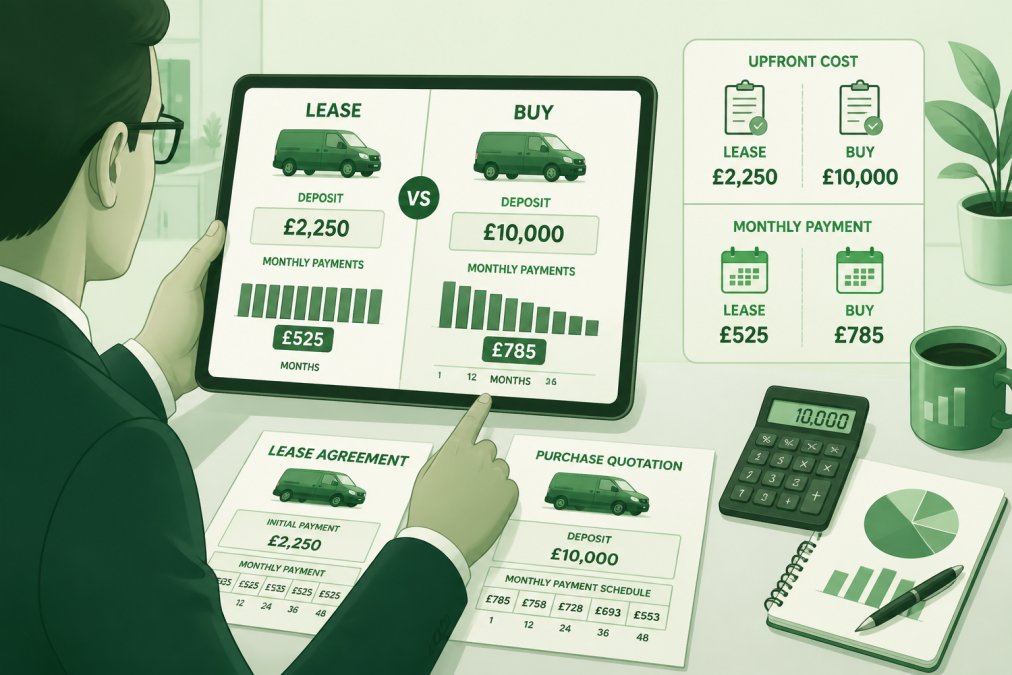
For a typical commercial van, pricing depends on quantity, dates, and delivery. These payments are fixed and can include maintenance, eliminating surprise repair bills.
With hire purchase, monthly payments are typically higher because you're paying off capital plus interest. Once the agreement ends, you own the asset and have built equity.
Contract hire spreads the cost of using a van across its rental period; hire purchase spreads the cost of owning one. For businesses with unpredictable growth, contract hire's lower upfront commitment offers flexibility. For stable businesses, hire purchase builds long-term asset value.
If you're exploring contract hire options, OVL Group regularly offers Van Leasing Special Offers that can reduce your monthly outlay further, making this route even more cost-effective for qualifying businesses.
Tax Implications and Capital Allowances
Understanding your tax position is essential before choosing either route.
Contract hire and tax: Monthly lease payments are fully tax-deductible as business expenses. There's no capital allowance to claim because you never own the asset. For VAT-registered businesses, you can reclaim VAT charged on lease payments, making contract hire particularly tax-efficient.
Hire purchase and capital allowances: When you purchase a van via hire purchase, you can claim capital allowances against corporation tax. Under current HMRC rules, most commercial vehicles qualify for the Annual Investment Allowance (AIA), allowing you to deduct the full purchase price from taxable profits in the year of purchase, up to the annual limit.
However, you must own the vehicle to claim allowances. With hire purchase, you don't own the van until the final payment is made, which delays the tax benefit.
VAT recovery also differs. With hire purchase, VAT on the purchase price is payable upfront. If VAT-registered, you can reclaim it. With contract hire, VAT is built into monthly payments and reclaimed continuously. For small businesses below the VAT threshold, hire purchase loses the VAT recovery advantage, making contract hire more tax-efficient.
Tax Aspect | Contract Hire | Hire Purchase |
|---|---|---|
Monthly payments deductible | Yes, 100% | Only interest portion |
Capital allowances | None | Yes, up to AIA limit |
VAT recovery | On monthly payments | On purchase price |
Balancing charge risk | None | Yes, if vehicle appreciates |
Maintenance, Repairs and Wear and Tear
Maintenance responsibility is one of the most practical differences between leasing and buying.
With contract hire, maintenance is typically included in your monthly payment. The leasing company arranges servicing, repairs, and replacement of wear-and-tear items. This predictability eliminates surprise repair bills, and your maintenance cost is fixed for the contract duration.
The catch: the leasing company specifies how maintenance must be carried out. You're usually required to service at authorised dealers on a prescribed schedule.
With hire purchase, you own the van and are responsible for all maintenance and repairs. You can choose any mechanic or defer non-critical repairs. This flexibility suits businesses with in-house maintenance capability or established mechanic relationships.
However, ownership means unpredictability. A major repair can cost thousands and arrive without warning. Your budget must accommodate these risks.
At contract end with leased vans, the leasing company assesses the vehicle's condition. If wear and tear exceeds "fair wear and tear," you'll face charges.
Mileage Allowances and Excess Charges
Mileage limits are a defining feature of contract hire agreements and often a source of unexpected costs.
Most contract hire agreements include an annual mileage allowance, typically 10,000 to 20,000 miles per year. If you exceed this allowance, you pay excess mileage charges, usually 8p to 15p per mile over the limit. Calculating your actual mileage requirement before signing is essential, as many businesses underestimate usage.
Hire purchase eliminates mileage concerns. Once you own the van, you can drive it as much as needed without penalty. This matters enormously for field service businesses, care providers, or logistics operations where vehicle usage is high and variable.
However, high mileage accelerates depreciation and increases maintenance costs. When you eventually sell the vehicle, higher mileage reduces its residual value.
For businesses with predictable, moderate mileage, contract hire's fixed allowance works well. For high-mileage operations, hire purchase's unlimited usage is more cost-effective despite depreciation impact.
Van Finance Options for Small Business
Small businesses face different constraints than larger fleet operators. Capital is tighter, tax positions vary more widely, and administrative burden matters more.
Contract hire for small businesses: Monthly payments are lower and more predictable, helping with cash flow management. Maintenance is included, reducing administrative complexity. For small businesses without dedicated fleet management, this simplicity is valuable.
The downside: small businesses often have variable usage patterns. If you sign a contract with a 15,000-mile allowance and your actual usage is higher, you're paying excess charges that could have been avoided with ownership.
Hire purchase for small businesses: If your business is profitable and you can claim capital allowances effectively, hire purchase's tax benefits are substantial. The challenge: hire purchase requires either a deposit upfront or access to finance. For cash-constrained small businesses, this is a barrier. Additionally, you're responsible for maintenance, which requires in-house capability or reliable mechanic relationships.
For small businesses with strong tax positions and stable, predictable usage, hire purchase often delivers better total cost of ownership. For small businesses with tight cash flow or highly variable usage, contract hire's simplicity and fixed costs are more appropriate.
HMRC Van Tax Rules and VAT Recovery
Understanding HMRC rules on vehicle finance and taxation is essential for accurate tax planning.
Capital allowances under HMRC rules: Most commercial vans qualify for capital allowances when purchased. The Annual Investment Allowance (AIA) allows businesses to deduct the full purchase price from taxable profits in the year of purchase, up to the annual limit set by HMRC. However, the van must be owned by your business to claim allowances. With hire purchase, ownership transfers only at the end of the agreement, which delays your ability to claim.
VAT recovery: If your business is VAT-registered, VAT recovery is a significant factor in total cost calculation. With contract hire, VAT is included in the monthly rental and reclaimed on your VAT returns. With hire purchase, VAT is added to the purchase price upfront, but you can reclaim it if VAT-registered.
The timing matters. With contract hire, VAT recovery is spread across the contract period. With hire purchase, you reclaim VAT upfront, improving cash flow in the purchase year.
Balancing allowances and charges: When you eventually sell a vehicle you've claimed capital allowances on, HMRC calculates a balancing allowance or charge. If the vehicle sells for less than its written-down value, you claim a balancing allowance (additional tax relief). If it sells for more, you face a balancing charge (additional tax liability). This is a real cost that reduces your effective saving from the original capital allowance.
Contract hire and HMRC: HMRC treats contract hire payments as revenue expenses, not capital expenditure. There are no capital allowances to claim, no balancing charges, and no asset ownership. This simplicity appeals to businesses wanting to avoid tax complexity.
Total Cost of Ownership and Exit Strategies
Comparing leasing vs buying vans for business requires calculating true total cost of ownership (TCO), not just monthly payments, but every cost associated with using the vehicle over its contract period.
Total cost of ownership for contract hire: Start with monthly rental multiplied by contract length. Add any expected excess mileage charges and insurance. The total is your cost to use the van for the contract period. There are no surprises because maintenance is included and the residual value risk is the leasing company's.
Total cost of ownership for hire purchase: Start with monthly payment multiplied by contract length. Add expected maintenance and repair costs. Add insurance. Subtract the residual value of the vehicle at contract end. You own the van at the end, which you can sell, trade in, or continue using.
The hire purchase option may appear cheaper, but it requires you to accurately predict maintenance costs and residual value. If maintenance runs higher or the vehicle's market value drops unexpectedly, your actual cost rises.
Exit strategies and early termination: Contract hire agreements lock you in for the contract term. Early termination usually incurs significant penalties. This inflexibility is a real cost if your business needs change unexpectedly.
Hire purchase agreements also have early termination costs, but they're typically lower because you have equity in the vehicle. If you've paid a substantial portion of the purchase price and need to exit, you can sell the van and use the proceeds to settle remaining finance. This flexibility is valuable for growing businesses.
Choosing between leasing vs buying vans for business requires honest assessment of your business's cash flow, tax position, maintenance capability, and usage patterns. There's no universally correct answer, only the right choice for your specific circumstances. At OVL Group, we provide whole life cost analysis that accounts for finance, fuel, servicing, maintenance and repair, insurance, and tax implications. Our team helps you model both scenarios with your actual numbers, so you can make a decision based on your business's financial reality. We also offer Vehicle Leasing Special Offers across our range to help reduce your overall costs. Get in touch to discuss your fleet requirements and discover how a tailored leasing or finance solution can optimise your operational costs and drive business growth.
Frequently Asked Questions
Are van lease payments 100% tax-deductible for UK businesses?
For VAT-registered businesses, lease payments are typically tax-deductible as business expenses. However, VAT recovery depends on your business structure and use of the van. If the van is used wholly for business purposes, you can reclaim VAT on lease payments. If it's used partly for personal use, VAT recovery may be restricted. Consult HMRC guidance or a tax adviser for your specific circumstances, as rules vary by business type and vehicle classification.
What is the difference between Contract Hire and Finance Lease when leasing vs buying vans for business?
Contract Hire (operating lease) means you never own the van; you pay fixed monthly instalments and return it at the end. Maintenance is typically included. Finance Lease (capital lease) is closer to buying: you gain asset ownership at the end and claim capital allowances against profits, though you still make monthly payments and cover maintenance. Hire Purchase is the closest to traditional buying, with ownership passing to you after the final payment, but you bear all maintenance costs and depreciation risk.
What are the main disadvantages of leasing a van compared to buying?
Key drawbacks include: no asset ownership at contract end; mileage limits with excess charges if exceeded; potential charges for wear and tear beyond normal use; less flexibility if your business needs change; and you cannot modify the vehicle. However, you avoid depreciation risk and benefit from predictable fixed costs. For businesses with stable mileage and no customisation needs, these trade-offs may be acceptable.
How does VAT recovery differ between leasing and buying a van?
When leasing, VAT-registered businesses can reclaim VAT on lease payments if the van is used for business. When buying via Hire Purchase or outright, VAT on the purchase price is payable upfront, but you can reclaim it in full if the van is used wholly for business. Leasing spreads VAT recovery across the lease term, while buying concentrates it in one payment. Both approaches offer VAT recovery, but the timing and cash flow impact differ significantly.
Is it best to lease a van if self-employed?
Self-employed individuals can lease vans and claim lease payments as business expenses, reducing taxable profit. However, you cannot claim capital allowances on leased vehicles. If you prefer ownership and long-term asset building, Hire Purchase or outright purchase may suit better, as you can claim capital allowances. Consider your cash flow, expected mileage, and whether you want to own the asset at the end. A whole life cost analysis comparing both options is essential for your specific circumstances.