
Table of Contents
- Understanding EV Fleet Charging Needs and Cost Drivers
- Smart Charging for Electric Fleets: Reducing Peak Demand
- Optimising Time-of-Use Electricity Rates
- Demand Charge Management for EV Fleets
- Charging Infrastructure Planning and Installation
- Government Incentives for EV Fleet Charging Infrastructure
- Managing Mixed Fleet Charging: ICE and EV Integration
- Fleet Management Software and Cost Monitoring
Manage Electric Fleet Charging Costs: A 2026 Guide
Last Updated: July 17, 2026
Learning how to manage electric fleet charging costs has become essential for organisations operating electric vehicles at scale. The shift toward EV adoption brings operational complexity across charging infrastructure, electricity tariffs, demand management, and regulatory incentives, all directly impacting your bottom line. OVL Group's analysis of hundreds of fleet operations reveals a clear pattern: organisations taking a strategic approach to charging management reduce energy expenditure by 20-35% compared to those treating it as an afterthought.
The real opportunity lies in orchestrating a blend of charging options paired with intelligent scheduling and infrastructure that matches your actual operational patterns, rather than treating charging as a simple binary choice between home and public networks.
Understanding EV Fleet Charging Needs and Cost Drivers
The total cost of operating an electric fleet extends far beyond vehicle purchase price. Electricity consumption represents only one component; infrastructure investment, demand charges, and grid coordination fees can dwarf fuel savings if managed poorly.
Several factors determine your charging expenses: vehicle range and battery capacity dictate charging frequency and energy consumption; operational patterns determine whether you can rely on slow, cheap charging or need expensive fast-charging; local electricity tariffs, particularly time-of-use rates and demand charges, can swing costs by 40% or more; and electrical capacity at your depot may require expensive infrastructure upgrades.
Conduct a thorough assessment before committing capital. Map your fleet's typical daily mileage, charging windows, and return patterns. Calculate your local utility's peak demand charges, these often surprise organisations that have only considered per-kilowatt-hour rates. Request a site assessment from your electricity supplier to understand grid capacity constraints and upgrade costs.
Smart Charging for Electric Fleets: Reducing Peak Demand
Smart charging systems represent the most direct lever for cost reduction. Rather than allowing vehicles to charge at maximum power whenever plugged in, intelligent systems distribute load across time periods, avoiding expensive peak demand windows and spreading consumption across cheaper off-peak hours.
When multiple vehicles charge at full power simultaneously, you trigger demand charges based on that peak consumption, charges that apply to your entire billing period even if the peak lasts only 15 minutes. Smart charging prevents this by staggering sessions, reducing the peak load your facility draws from the grid.
Dynamic load management (DLM) continuously adjusts individual charger outputs based on real-time grid conditions, vehicle readiness, and operational constraints. A fleet charging 20 vehicles simultaneously at 11 kW each (220 kW total draw) incurs demand charges based on that 220 kW peak. The same fleet using DLM to spread those vehicles across a two-hour window with staggered 50 kW peaks reduces peak demand by 77% and corresponding demand charges by similar margins.
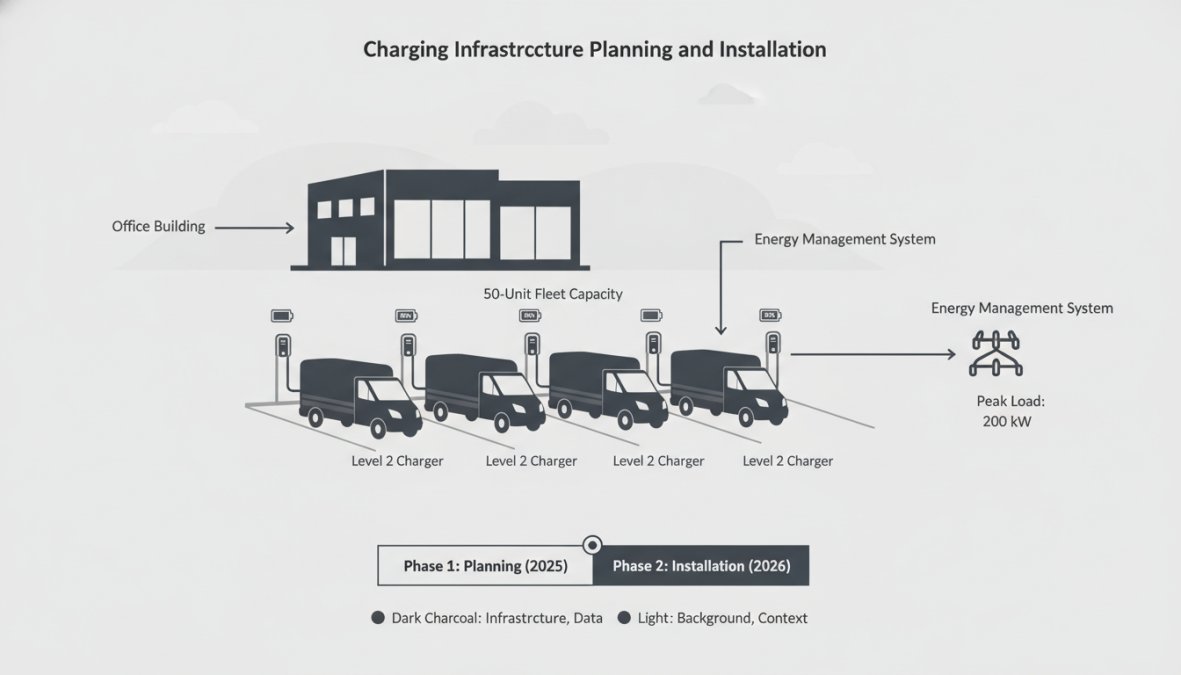
Implementation requires compatible charging hardware (most modern Level 2 and DC fast chargers support smart charging protocols), a central energy management system that orchestrates charging decisions, and integration with your fleet management software. The investment typically pays for itself within 18-24 months through demand charge reduction alone.
Optimising Time-of-Use Electricity Rates
Time-of-use (TOU) tariffs are standard across most UK electricity suppliers, yet many fleet operators fail to align charging behaviour with these rate structures. TOU tariffs divide the day into periods, off-peak (night hours, weekends), shoulder (early morning, early evening), and peak (mid-morning through late afternoon), with rates varying by as much as 300% between periods. Off-peak rates might be 15p per kWh while peak rates reach 45p per kWh. A 50 kWh charge costs £7.50 during off-peak but £22.50 during peak.
Fleet vehicles that operate during standard business hours and return to depot in the evening can charge overnight during off-peak windows at minimal cost. This single shift, moving charging from daytime to night, reduces electricity costs by 40-50% for predictable operations.
More sophisticated approaches layer in weather forecasts, grid demand signals, and vehicle-to-grid (V2G) capabilities. Some organisations charge vehicles during cheap off-peak windows even when immediate charging isn't required, storing energy in vehicle batteries. During expensive peak periods, those vehicles can draw minimally or, if equipped with V2G capability, discharge power back to the grid and earn revenue.
Demand Charge Management for EV Fleets
Demand charges are often misunderstood but represent one of the largest controllable costs in fleet electrification. A demand charge is a fee based on your highest 15-minute average power consumption during a billing period, applied monthly regardless of actual usage.
Suppose your fleet's highest 15-minute average consumption in a month is 150 kW. Your utility charges £8 per kW of demand capacity, resulting in a £1,200 monthly demand charge. If you'd managed that same charging event to peak at only 100 kW instead, that charge drops to £800, a £400 saving that month, or £4,800 annually.
Strategies to minimise peak demand spikes centre on staggering charging sessions so vehicles never charge simultaneously at full power, understanding your utility's demand charge calculation window, and considering battery storage or demand response partnerships. A 50-vehicle fleet charging overnight with smart load management can keep peak demand at 60 kW by staggering chargers across an 8-hour window. Without load management, the same fleet might create 200 kW peaks. At £8 per kW, that's a £1,120 monthly difference, £13,440 annually.
Charging Infrastructure Planning and Installation
Choosing the right charging infrastructure requires balancing capital cost, operational flexibility, and future scalability. Infrastructure decisions made today constrain your options for years.
Engage a qualified electrician to evaluate your depot's current electrical service before any equipment purchase. Most facilities require upgrades to support fleet charging. Request a formal site assessment that quantifies upgrade costs, timelines, and any grid connection fees. The assessment should also map your physical layout and identify constraints on charger positioning and future expansion.
Choosing charger types depends on operational patterns. Level 1 chargers (1.4 kW) suit vehicles spending extended periods at depot. Level 2 chargers (7-22 kW) represent the standard for fleet depot charging, delivering 30-80 miles of range overnight. DC fast chargers (50-350 kW) suit fleets requiring rapid turnaround or longer-range operations, but their capital cost makes them suitable primarily for high-traffic networks or large operations.
Most fleet operations deploy mixed infrastructure: Level 2 chargers at the depot for overnight charging (the cheapest option), supplemented by DC fast chargers at strategic locations for vehicles requiring mid-route charging. This hybrid approach balances cost, flexibility, and charging speed.
Government Incentives for EV Fleet Charging Infrastructure
The UK government offers several schemes to offset charging infrastructure costs. The Workplace Charging Scheme provides grants covering up to 75% of installation costs, capped at £350 per socket. For organisations planning 10 chargers, this represents up to £3,500 in direct funding. Capital allowances allow businesses to claim tax relief on charging infrastructure investment through corporation tax depreciation.
To apply for funding, identify which schemes you're eligible for (most require business use and UK location), gather quotes from approved installers, and submit applications through the relevant program portal. Processing typically takes 4-8 weeks. Plan applications before purchasing equipment, as some schemes require pre-approval before installation begins.
Managing Mixed Fleet Charging: ICE and EV Integration
Most organisations operate mixed fleets, internal combustion engine vehicles alongside EVs, for extended periods. This creates unique operational and cost management challenges.
Install charging infrastructure sized for your planned EV fleet in 12-24 months, not your current vehicle count. This avoids over-investing in ICE-era infrastructure while ensuring adequate capacity as EV adoption accelerates.
Operationally, assign ICE vehicles to routes where range, payload, or specialised equipment demands exceed EV capabilities. Assign EVs to routes where their range, operational cost, and environmental benefits apply. An EV's electricity cost, approximately 3-4p per mile in off-peak charging, is roughly one-third the fuel cost of an equivalent ICE vehicle. A vehicle operating 30,000 miles annually saves £900-1,200 in fuel costs, which might justify a £5,000 capital premium but not a £15,000 premium.
For organisations evaluating whether to purchase or lease their electric fleet, [Electric / Hybrid Leasing](https://www.ovl.co.uk/electric-hybrid-leasing) provides a flexible alternative that removes the capital burden of vehicle acquisition while allowing you to focus resources on charging infrastructure and operational optimisation. Leasing also simplifies the transition from mixed ICE and EV fleets, as you can adjust vehicle mix based on evolving operational needs.
Fleet Management Software and Cost Monitoring
You cannot manage what you don't measure. Fleet management software transforms raw charging data into actionable insights about consumption patterns and optimisation opportunities.
Key features include real-time vehicle location and battery state-of-charge monitoring, charging event logging that reveals driver behaviour patterns, energy consumption tracking showing kWh per mile, and integration with utility billing data to map charging events against TOU rates.
Establish baselines before implementing optimisation measures. Measure your fleet's average cost per mile, peak demand charges, and off-peak versus peak consumption ratios for 2-3 billing cycles. Then implement specific measures and remeasure after 2-3 cycles to quantify impact.
Most organisations discover that the largest opportunities lie in demand charge reduction and off-peak consumption shift. A fleet reducing peak demand by 30% through load management might save £200-400 monthly. A fleet shifting 20% of consumption from peak to off-peak windows might save £150-300 monthly. These compound to £4,000-8,000 annually.
| Optimisation Strategy | Implementation Effort | Typical Annual Saving | Payback Period |
|---|---|---|---|
| Smart load management | Medium (software + training) | £4,000-8,000 | 12-18 months |
| Time-of-use scheduling | Low (operational discipline) | £2,000-4,000 | Immediate |
| Infrastructure upgrade (capacity) | High (capital + installation) | £3,000-6,000 | 24-36 months |
| Demand response programs | Low (enrollment + coordination) | £1,500-3,000 | 6-12 months |
| Battery storage integration | High (capital + controls) | £5,000-10,000 | 36-48 months |
Practical Implementation: A Step-by-Step Approach
Begin with assessment: measure your current electricity costs, identify peak demand periods, and calculate your fleet's charging requirements. This baseline allows you to quantify the impact of later optimisations.
Next, implement low-cost operational changes. Shift charging to off-peak windows through schedule discipline. Enrol in your utility's demand response programs, which typically require only enrollment and can yield 15-25% savings immediately.
Then, invest in smart charging infrastructure. Upgrade your charging system to support load management and integrate it with your fleet management software. This typically requires 8-12 weeks but delivers ongoing savings through automated demand management.
Finally, consider longer-term infrastructure investments: battery storage systems, vehicle-to-grid integration, or dedicated microgrid solutions. These require substantial capital but can reduce peak demand by 40-60%.
Managing electric fleet charging costs effectively requires orchestrating multiple levers: infrastructure planning, rate optimisation, demand management, and operational discipline. Organisations achieving the largest savings treat charging as a core operational system requiring strategic attention. OVL Group's tailored fleet management solutions help organisations optimise their entire fleet lifecycle, including comprehensive charging cost analysis. Through our whole life cost analysis and Electric / Hybrid Leasing, we help fleets understand the true cost of electrification and identify strategies delivering measurable savings. Explore how strategic fleet planning, supported by dedicated account management and cost analysis, can transform your charging costs and drive sustainable fleet growth.
Frequently Asked Questions
What is the best way to manage electric fleet charging costs?
The most effective approach combines three strategies: implementing smart charging systems to avoid peak demand charges, negotiating time-of-use electricity rates with your utility provider, and deploying fleet management software to monitor energy consumption in real time. Start with a comprehensive site assessment to understand your electrical capacity and charging patterns, then prioritise infrastructure upgrades and rate optimisation based on your fleet's specific usage profile and operational needs.
How can smart charging reduce energy costs for electric fleets?
Smart charging for electric fleets uses dynamic load management to distribute charging across off-peak hours when electricity rates are lower, preventing simultaneous charging that triggers expensive demand charges. By automating charging schedules based on vehicle availability, energy prices, and grid capacity, smart systems can reduce overall energy costs by 15-30% depending on your utility's rate structure. Integration with an energy management system allows real-time optimisation of when and how much each vehicle charges.
Are there government incentives available for electric fleet charging infrastructure?
Yes, the UK offers several schemes to support EV fleet adoption. These include grants for workplace charging infrastructure and tax allowances on capital expenditure for charging equipment. Eligibility and funding levels vary by region and fleet size. Contact your local authority or visit government business support websites to identify current programmes. Many businesses also benefit from reduced vehicle tax and fuel duty savings when operating electric vehicles, which offset charging infrastructure costs over the vehicle's lifetime.
What factors impact electric fleet charging operational costs the most?
The primary cost drivers are electricity rates (particularly peak demand charges), charging infrastructure installation and maintenance, vehicle utilisation rates, and charger efficiency. Time-of-use rates, demand charges during peak hours, and the electrical capacity of your site significantly influence total cost of ownership. Additionally, the mix of charger types (Level 2 versus DC fast chargers), frequency of charging, and battery health all play roles. Regular monitoring through fleet management software helps identify cost-saving opportunities across these variables.