Table of Contents
- Why Care Providers Are Outsourcing Fleet Management
- Cost-Benefit Analysis of Fleet Outsourcing for Care Businesses
- CQC Vehicle Compliance Requirements and Outsourced Management
- Fleet Management Software for Care Homes: What It Delivers
- In-House vs. Outsourced Fleet Management: The Trade-Offs
- Managing the Transition to Outsourced Fleet Services
- Conclusion
Last Updated: August 10, 2026
Why Care Providers Are Outsourcing Fleet Management
Care providers managing 30 to 80+ vehicles face relentless operational demands: maintenance schedules, compliance tracking, fuel management, driver safety, and regulatory reporting. Most care organisations aren't fleet specialists, they're healthcare operators trying to keep vehicles on the road without the expertise to do it efficiently.
Outsourcing fleet management has become standard practice for domiciliary care businesses, residential homes, and community health services across the UK. The shift isn't about cutting corners; it's about focusing internal resources on patient care while delegating vehicle management to specialists who understand both operational complexity and regulatory requirements.

Vehicle lifecycle management demands expertise disconnected from your core mission. Outsourced providers handle bulk procurement, maintenance scheduling, compliance administration, and asset use more cost-effectively than in-house teams.
According to the Care Quality Commission's guidance on duty of care, care providers must ensure vehicles meet safety and compliance standards. This is a regulatory obligation. Outsourced fleet management providers specialise in meeting these requirements: they understand CQC vehicle compliance, HMRC regulations around salary sacrifice schemes, and preventative maintenance schedules that prevent costly breakdowns.
OVL Group has supported care-based businesses through this transition, helping organisations move from in-house fleet management to dedicated fleet administration services. Organisations that outsource see immediate improvements in cost consolidation, administrative burden reduction, and compliance certainty. For those looking to refresh their fleet, Vehicle Leasing Special Offers and Van Leasing Special Offers can help reduce acquisition costs when transitioning to outsourced management.
Cost-Benefit Analysis of Fleet Outsourcing for Care Businesses
Outsourcing fleet management delivers measurable financial benefits. Total cost of ownership, not just line-item costs, is what matters.
In-house fleet management requires paying for vehicles, fuel, maintenance, insurance, tax, and administrative overhead. Your Finance Director spends time on fleet reporting. Your Operations Manager handles breakdown support. Your team tracks service agreements with repair shops. These activities consume capacity that could be deployed elsewhere.
An outsourced fleet provider consolidates costs into a single operational expenditure figure. You know your monthly cost, what's included, and who's responsible when something breaks. That clarity reduces financial risk and improves budget predictability.
Preventative maintenance scheduling reduces vehicle downtime. Bulk procurement of parts and services lowers per-unit costs. Fuel card management and telematics integration provide visibility into consumption patterns. Risk mitigation improves because professional providers carry insurance and liability protection exceeding most in-house operations.
For domiciliary care providers, outsourcing removes the need to maintain dedicated fleet management staff. You pay a management fee in exchange for predictable costs, reduced administrative burden, and access to expertise you don't have in-house. Most organisations find that operational expenditure savings and efficiency gains exceed the management fee within 12 to 18 months of transition.
CQC Vehicle Compliance Requirements and Outsourced Management
Care providers operate under regulatory scrutiny that general fleet operators do not face. The Care Quality Commission's Key Lines of Enquiry (KLOE) framework explicitly assesses whether vehicles used in care delivery are safe, well-maintained, and operated by competent drivers. Vehicle safety is embedded in the CQC's assessment of "Safe" and "Well-Led" domains, and non-compliance directly affects your inspection rating.
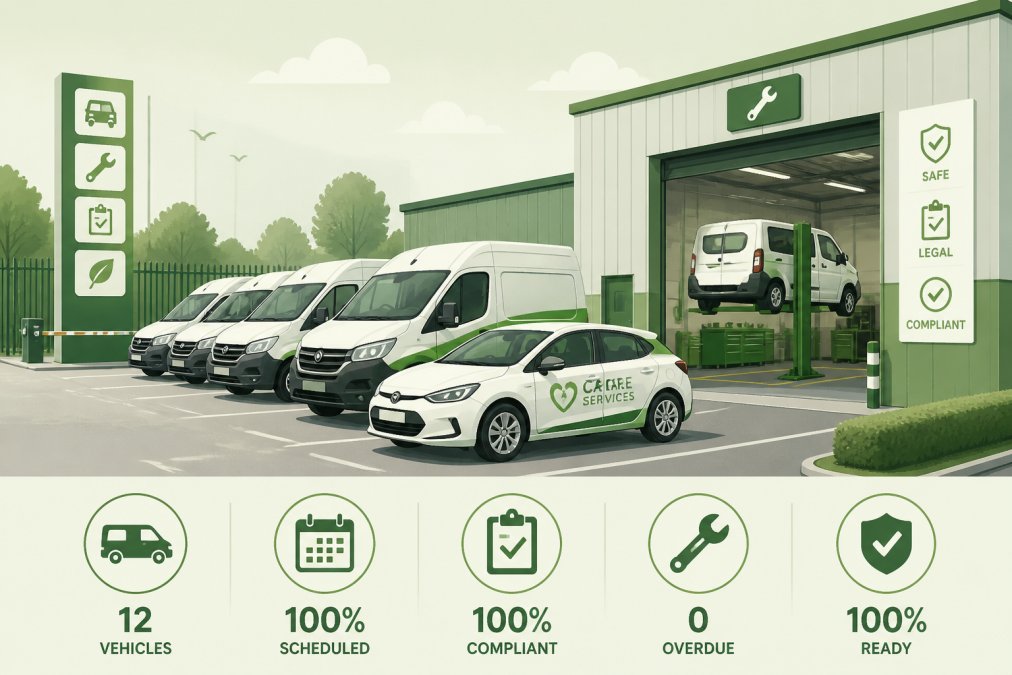
Care-sector vehicle standards address three specific risk areas: patient safety during transport (accessibility standards, hygiene protocols), duty of care documentation (driver conduct policies, maintenance schedules, incident reporting), and regulatory alignment (DVSA standards, HMRC regulations, specialist care transport insurance).
Your fleet must have:
- MOT certification current for every vehicle (annual for cars and vans, six-monthly for minibuses over 3.5 tonnes)
- Maintenance records documenting all servicing, repairs, and safety checks, retained for a minimum of three years
- Driver checks including DVLA licence verification, medical fitness assessments, and safeguarding clearance (DBS checks for drivers transporting vulnerable people)
- Vehicle safety inspections beyond MOT, quarterly safety audits covering brakes, tyres, lights, and emergency equipment
- Insurance documentation proving cover is adequate for care transport use
- Incident and near-miss logs showing how vehicle-related safety events are investigated
When a CQC inspector visits, they will ask to see your fleet compliance file and verify that MOT certificates are current, maintenance records are complete, and driver documentation is in order. If evidence is missing or incomplete, the inspector will rate this as a breach of the Health and Social Care Act 2008 (Regulated Activities) Regulations 2014, resulting in a "Requires Improvement" or "Inadequate" rating.
Outsourced fleet management providers specialising in care sector compliance automate this process. They maintain a centralised compliance calendar flagging upcoming MOT dates, service intervals, and driver check renewals. They generate compliance reports on demand, critical when preparing for CQC inspection. They integrate with DVLA systems to verify driver licences automatically and maintain audit trails proving due diligence.
The advantage over in-house management is defensibility. When an inspector asks, "How do you ensure your fleet meets safety standards?", an outsourced provider's documented processes and automated compliance tracking provide a stronger answer than a spreadsheet and folder of invoices.
Care providers managing minibuses face additional complexity. Minibuses over 3.5 tonnes used for care transport require enhanced driver training (PCV category on the DVLA licence), tachograph installation and monitoring, specialist insurance for passenger liability, and accessibility compliance (wheelchair lifts, securing systems, emergency exits meeting BS EN standards). An outsourced provider experienced in care transport will ensure your minibus fleet meets every standard, producing evidence on demand.
Fleet Management Software for Care Homes: What It Delivers
Modern fleet management software integrates telematics (vehicle tracking and diagnostics), maintenance scheduling, fuel management, and reporting into a single platform.
For care homes and domiciliary care providers, the software delivers three core benefits: visibility (knowing where vehicles are and how they're used), efficiency (maintenance scheduled automatically based on vehicle condition and mileage), and compliance (all service records, MOT dates, and driver checks logged automatically, creating audit trails satisfying regulatory requirements).
A practical example: a care provider using fleet management software can set alerts for upcoming MOT dates across their entire fleet. The system flags vehicles 30 days before expiry, schedules the test, and logs the result automatically. No spreadsheet. No missed deadlines.
The software also enables driver safety protocols. Telematics data shows harsh braking events, speeding, and unsafe manoeuvres, allowing you to identify drivers needing additional training and reduce accident risk. Fuel card management tracks consumption per vehicle, identifies anomalies indicating theft or mechanical problems, and provides data for carbon footprint reduction initiatives.
Implementing fleet management software requires technical integration, staff training, and ongoing system management. Outsourced providers handle this complexity, deploying the software, integrating it with your existing systems, and managing updates and support.
In-House vs. Outsourced Fleet Management: The Trade-Offs
The decision between managing your fleet in-house or outsourcing isn't about cost alone. It's about capability, scalability, and strategic focus.
Factor | In-House Management | Outsourced Management |
|---|---|---|
Initial Setup | Requires hiring, systems investment | Managed by provider, faster deployment |
Monthly Cost Predictability | Variable (fuel, maintenance, labour) | Fixed operational expenditure |
Compliance Expertise | Limited unless staff have fleet experience | Specialist knowledge, regulatory alignment |
Scalability | Difficult; requires hiring when growing | Flexible; provider scales with you |
Technology Investment | You maintain systems and software | Provider maintains; included in service |
Administrative Burden | High; requires dedicated staff time | Low; provider handles reporting |
Risk Management | You carry liability and insurance risk | Provider carries professional liability |
Control Over Decisions | Complete; you decide everything | Shared; provider advises, you approve |
In-house management works well for organisations with stable, small fleets (under 20 vehicles). Outsourced management makes sense for organisations with 30+ vehicles, growth plans, or limited internal expertise. Most mid-market care organisations find that outsourced management delivers better total cost of ownership by reducing administrative overhead, improving compliance certainty, and eliminating the need to hire dedicated fleet staff.
Managing the Transition to Outsourced Fleet Services
Switching from in-house to outsourced fleet management requires a structured transition roadmap addressing four critical phases: audit, selection, handover, and stabilisation.
Phase 1: Fleet Audit (Weeks 1-2)
Conduct a comprehensive fleet audit documenting vehicle inventory (registration number, make/model, year, current mileage, condition), maintenance history (servicing records for the past 24 months, outstanding repairs), compliance status (MOT expiry dates, tax disc status, insurance expiry, driver licence verification records), usage patterns (average monthly mileage, peak usage periods), current costs (fuel, maintenance, insurance, tax, staff time), and operational dependencies (which vehicles are critical to daily operations).
Phase 2: Provider Selection and Contract Negotiation (Weeks 3-5)
When evaluating outsourced providers, ask for references from other care organisations they manage. Ask how they handle CQC compliance, response time for breakdown support, and experience with your fleet size and vehicle types.
During contract negotiation, establish clear service level agreements (SLAs) specifying breakdown response time, maintenance scheduling, compliance reporting frequency, communication protocol, data access, and exit terms. Insist that the contract includes a transition support clause, the provider should commit to a structured handover process.
Phase 3: Handover and System Integration (Weeks 6-8)
The handover phase should follow this sequence: documentation transfer (provide the provider with your fleet audit and all records; they upload into their system and validate against DVLA and MOT records), system access and training (the provider grants your team access to their fleet management platform and conducts training), driver communication (issue a memo to all drivers explaining the transition), parallel running (for two weeks, maintain a parallel process where your in-house team and the outsourced provider both track vehicle status), and go-live (the outsourced provider assumes full responsibility; schedule weekly check-ins for the first month, then move to monthly).
Phase 4: Stabilisation and Optimisation (Weeks 9-16)
Expect a 4-6 week bedding-in period. Monitor compliance (verify the provider is meeting SLAs), track cost changes (compare monthly costs to baseline; savings typically emerge by month 3-4), gather feedback from drivers, and review the compliance report carefully.
After 8-12 weeks, you should see clear evidence that the transition is working: compliance is documented, maintenance is scheduled proactively, and your team is spending less time on fleet administration.
Common Transition Mistakes to Avoid
- Incomplete handover documentation: spend time on the fleet audit so the provider can establish proper processes
- Unclear communication with drivers: be explicit about what's changing and what's staying the same
- Expecting immediate savings: fleet management improvements take 3-4 months
- Passive account management: schedule regular check-ins and ask specific questions about compliance risks
- Ignoring the bedding-in period: trust the process but verify the results
Measuring Success
After 12 weeks, assess the transition against these metrics: compliance (100% of vehicles have current MOT, tax, and insurance; all driver checks are current; zero compliance gaps), downtime (average vehicle downtime for maintenance has decreased by at least 5%), cost (monthly fleet costs are predictable and documented; administration time has decreased by at least 50%), and satisfaction (your Operations Manager reports the provider is responsive; drivers report no disruption; account manager is proactive).
If you're hitting these metrics, the transition is successful. If you're missing them, escalate with the provider and discuss corrective actions.
Frequently Asked Questions
What are the main benefits of outsourcing fleet management for care providers?
Outsourcing reduces administrative burden, ensures regulatory compliance, and lowers total cost of ownership through bulk procurement and preventative maintenance scheduling. Care providers can redirect staff focus to patient care rather than vehicle logistics. Outsourced providers handle fuel management, insurance administration, and compliance reporting—freeing your team from paperwork and reducing risk of regulatory breaches.
How does outsourcing affect CQC vehicle compliance requirements?
Outsourced fleet management providers specialise in duty of care compliance and vehicle safety protocols required by CQC inspections. They manage maintenance scheduling, safety audits, and documentation—ensuring your vehicles meet regulatory standards consistently. This reduces your compliance risk and demonstrates to inspectors that vehicles are professionally maintained and tracked.
Is outsourcing cost-effective for small care providers with 20-30 vehicles?
Yes. Small providers benefit from scalability and cost consolidation through outsourced services. Rather than employing dedicated fleet staff, you pay for professional management and gain access to bulk procurement advantages. Whole life cost analysis—including finance, maintenance, fuel, and insurance—typically shows savings even for smaller fleets, plus eliminates unpredictable vehicle downtime.
What risks should care providers consider before outsourcing fleet management?
Key risks include service level agreement enforcement, potential loss of direct control over vehicle allocation, and transition disruption during switchover. Ensure your provider has proven experience with care sector compliance, clear escalation procedures for emergency breakdown support, and transparent reporting on asset utilisation and vehicle lifecycle management. Verify their track record with similar-sized operations.