Table of Contents
- Outsourced Fleet Management vs In-House: Key Differences Explained
- Pros and Cons of In-House Fleet Management
- Pros and Cons of Outsourced Fleet Management
- Total Cost of Ownership Fleet: In-House vs Outsourced
- In-House Fleet Management Best Practices and Software Tools
- Control, Customization, and Scalability Considerations
- Risk Management, Compliance, and Regulatory Requirements
- Hybrid Fleet Management: Bridging In-House and Outsourced Models
Last Updated: June 23, 2026
Outsourced Fleet Management vs In-House: Key Differences Explained
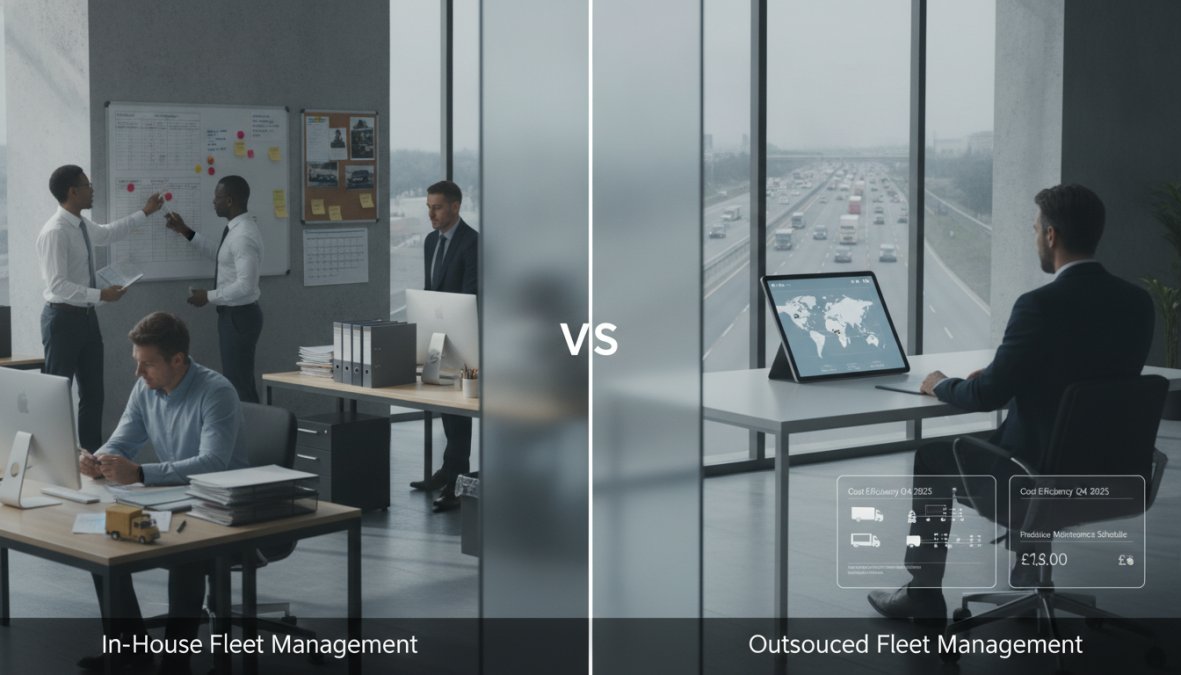
The decision between outsourced fleet management and in-house operations determines how businesses control costs, maintain compliance, and scale vehicle operations. OVL Group works with UK businesses navigating this question, and the answer rarely fits a simple pros-and-cons framework. Most organisations frame it as binary when the most effective approach often lies somewhere in between. Below, we break down every dimension of this decision.

According to the Fleet News Annual Fleet Industry Survey, fleet operating costs continue to rise due to regulatory changes, electrification mandates, and rising maintenance expenses. This context matters when evaluating which management model delivers the best total cost of ownership for your fleet.
What Is In-House Fleet Management?
In-house fleet management means managing all vehicle acquisition, maintenance scheduling, compliance, driver administration, and reporting using internal staff, systems, and resources. The business retains full operational control and typically invests in fleet software and telematics infrastructure.
What Is Outsourced Fleet Management?
Outsourced fleet management is an arrangement where a specialist third-party provider handles some or all fleet operations, including procurement, preventive maintenance, compliance monitoring, and asset utilisation reporting, under a defined service level agreement. The business retains strategic oversight while the provider manages day-to-day administration.
Pros and Cons of In-House Fleet Management
Direct control is the clearest argument for keeping fleet operations in-house. When your team manages the fleet, decisions happen faster, institutional knowledge builds, and you can align fleet performance directly with operational priorities.
Pros of in-house management:
- Full visibility and control over vehicle uptime, driver behaviour, and maintenance schedules
- Faster response to operational changes without vendor dependency
- Ability to build bespoke processes around your specific fleet lifecycle
- Direct relationships with drivers, improving compliance and accountability
- Proprietary data stays internal, reducing third-party data risk
Cons of in-house management:
- High capital expenditure on fleet software, telematics hardware, and workshop infrastructure
- Ongoing technician training costs as vehicles become more technologically complex
- Regulatory compliance burden falls entirely on internal teams
- Scaling upward requires proportional increases in headcount and systems
- Core business activities suffer when management bandwidth is absorbed by fleet administration
A common mistake is underestimating total staffing cost. Fleet managers, administrators, and maintenance technicians represent significant operating expenses beyond direct vehicle costs. Many businesses discover this only after years of in-house operation.
Pros and Cons of Outsourced Fleet Management
Outsourcing transfers operational complexity to a specialist, but it also transfers some degree of control. That trade-off matters enormously depending on how central fleet operations are to your business model.
Pros of outsourced fleet management:
- Access to specialist expertise in fleet compliance, procurement, and lifecycle management
- Predictable operating expenses through fixed service level agreements
- Reduced capital expenditure on internal systems and headcount
- Providers negotiate better vehicle and maintenance pricing through scale
- Frees internal resource to focus on core business activities
Cons of outsourced fleet management:
- Less direct control over day-to-day fleet decisions
- Vendor management adds its own administrative layer
- Service quality depends heavily on provider capability and responsiveness
- Contract terms can limit flexibility during rapid fleet growth or contraction
- Proprietary operational data is held by a third party
The quality of the provider relationship determines most outcomes. A well-structured service level agreement with clear fleet performance metrics and escalation procedures closes much of the control gap. A poorly structured one creates the problems critics associate with outsourcing.
Total Cost of Ownership Fleet: In-House vs Outsourced
Total cost of ownership (TCO) is the only honest basis for comparing in-house and outsourced fleet management. Surface-level cost comparisons mislead because they capture direct vehicle costs while ignoring the full operating expense stack.
Capital Expenditure and Operating Expenses
In-house fleet management carries significant upfront capital expenditure: fleet software platforms, telematics hardware, workshop equipment, and infrastructure to support a fleet management team. These costs depreciate over several years, which can make in-house operations appear more cost-effective annually than they actually are.
Outsourced fleet management converts much of this capital expenditure into predictable operating expenses billed monthly or annually. For businesses with capital constraints or those prioritising balance sheet flexibility, this conversion is a material financial advantage.
Hidden Costs and Cost-Benefit Analysis
A rigorous cost-benefit analysis must account for hidden cost categories:
Cost Category | In-House | Outsourced |
|---|---|---|
Fleet software licences | High upfront + annual renewal | Included in service fee |
Technician training | Ongoing internal cost | Provider responsibility |
Compliance management | Internal staff time | Covered by SLA |
Procurement pricing | Market rate | Provider volume discount |
Downtime management | Internal coordination | Provider SLA commitment |
Scalability cost | Linear headcount increase | Flexible contract adjustment |
The TCO calculation should include staff time spent on fleet administration, not just direct vehicle costs. When internal management hours are costed at market rates, the gap between in-house and outsourced often narrows considerably.
In-House Fleet Management Best Practices and Software Tools
The biggest mistake in-house teams make is treating fleet software as an afterthought. The right tools determine whether your team operates proactively or remains permanently reactive to breakdowns and compliance failures.
Fleet Management Software Tools for In-House Operations
Choosing fleet software requires matching platform capability to fleet size and operational complexity. For small-to-mid-sized fleets, Fleetio offers automated maintenance scheduling, mobile driver inspection workflows, and straightforward fuel and expense tracking. For data-driven fleet managers needing deep customisation and advanced telematics analytics, Geotab provides engine diagnostics, fuel usage analytics, and extensive third-party integrations. Larger fleets requiring integrated safety monitoring often use Samsara, which combines real-time GPS tracking with AI-driven safety features and predictive maintenance alerts.
The right choice depends on whether your primary need is maintenance management, compliance monitoring, safety oversight, or all three. Avoid over-specifying: enterprise-grade software for a 20-vehicle fleet creates unnecessary complexity.
Preventive Maintenance and Vehicle Uptime
Preventive maintenance is where in-house fleet management delivers the clearest return. Unplanned downtime is consistently more expensive than scheduled servicing, both in direct repair costs and operational disruption.
Effective preventive maintenance programmes share three characteristics: automated scheduling triggered by mileage or engine hours, clear accountability for sign-off at each service interval, and a documented escalation path when vehicles flag diagnostic issues. Fleets implementing these practices typically see meaningful reductions in roadside breakdowns and recovery costs.
Control, Customisation, and Scalability Considerations
The outsourced fleet management vs in-house debate becomes genuinely interesting here, because the answer changes depending on fleet size and growth rate.
Direct Control vs Vendor Management
Direct control is not inherently superior to vendor management. What matters is whether the level of control matches the operational decisions you need to make quickly. Logistics operators or field service companies, where fleet performance is a direct competitive differentiator, genuinely need the rapid decision-making that in-house management provides. Professional services firms with company car schemes often find that the control premium of in-house management is not worth the administrative overhead.
Scaling Your Fleet: Size and Growth Implications
Fleet size is a reliable indicator of which model suits a business. Fleets under 25 vehicles are difficult to manage cost-effectively in-house because dedicated fleet management staff overhead is disproportionate to fleet value. At this scale, outsourced fleet management typically offers better resource allocation.
Fleets of 50 or more vehicles often reach a point where in-house management becomes cost-competitive, particularly in single regions with consistent vehicle types. Rapid growth creates specific challenges for in-house operations: scaling headcount and systems in parallel with fleet expansion is difficult without service degradation. Outsourced models handle volume changes more fluidly through contract adjustment.
For businesses exploring fleet renewal or expansion, Vehicle Leasing Special Offers and [Van Leasing Special Offers](https://www.ovl.co.uk/van-leasing/special-offers) can provide cost-effective options when evaluating procurement strategies, while Electric / Hybrid Leasing and Lease Used Electric Vehicles offer pathways to meet emissions compliance requirements without the capital burden of outright purchase.
Risk Management, Compliance, and Regulatory Requirements
Compliance carries the highest stakes in the in-house vs outsourced decision. UK regulatory requirements for commercial fleets continue to expand, covering driver licence checks, vehicle roadworthiness, working time regulations, and emissions standards tied to Clean Air Zone requirements.
According to the Driver and Vehicle Licensing Agency's operator compliance guidance, operators have a legal duty to ensure vehicles are maintained in a roadworthy condition and drivers hold valid licences. Failure carries serious consequences, including operator licence revocation.
In-house teams carry the full compliance burden internally, requiring current regulatory knowledge, strong documentation, and consistent enforcement. Outsourced providers typically offer compliance management as a core service, with specialist knowledge and operational risk management built in. This is a genuine risk mitigation argument for outsourcing, particularly for businesses without dedicated compliance expertise.
Outsourced providers with whole life cost analysis capabilities can identify optimal replacement points based on finance, fuel, SMR, insurance, and tax data combined.
Hybrid Fleet Management: Bridging In-House and Outsourced Models
The framing of outsourced fleet management vs in-house as binary is outdated. Most mature fleet operations in 2026 operate some form of hybrid model, retaining strategic control internally while outsourcing specific operational functions to specialists.
When a Hybrid Approach Works Best
A hybrid model works best when a business has clear operational reasons to retain direct control over certain functions while acknowledging that others are more efficiently handled by specialists. Common configurations include:
- In-house fleet managers handling driver management and compliance, with outsourced vehicle procurement and remarketing
- Internal telematics and data analysis, with outsourced preventive maintenance scheduling
- Outsourced fleet administration for standard company cars, with in-house management for specialist vehicles
The hybrid approach also works during transition periods: businesses can transfer functions incrementally, reducing operational risk.
Implementation Framework for Hybrid Operations
Implementing a hybrid model requires a clear framework to avoid duplicated effort and unclear accountability.
Step 1: Function mapping. List every fleet management function and categorise as: strategic (retain internally), operational (outsource), or transitional (currently in-house but suitable for outsourcing).
Step 2: Accountability assignment. Define a single accountable owner for each function, whether internal or external. Shared accountability breaks hybrid models.
Step 3: Service level definition. For outsourced functions, define specific performance metrics, reporting frequency, and escalation procedures before contract signature.
Step 4: Integration audit. Identify where data must flow between internal systems and the outsourced provider's platforms to avoid reporting gaps.
Step 5: Review cadence. Hybrid models require regular structured reviews, quarterly at minimum, with formal annual assessment of function allocation.
As noted in the Chartered Institute of Procurement and Supply's guidance on outsourcing governance, clear governance structures and defined performance metrics are the primary determinants of outsourcing success.
The hybrid model is not a compromise. For many businesses, it is the most commercially rational answer because it allocates each function to the party best placed to perform it efficiently.
Choosing between outsourced and in-house fleet management is one of the most consequential operational decisions a fleet-dependent business makes. OVL Group provides dedicated account management, whole life cost analysis covering finance, fuel, SMR, insurance, and tax, and the FleetManagerPlus system for simplified fleet administration, giving businesses the analytical foundation to make this decision with confidence.
Frequently Asked Questions
What are the main benefits of outsourced fleet management compared to in-house operations?
Outsourced fleet management reduces your internal administrative burden and staffing costs by transferring operational responsibility to a specialist provider. Outsourcing partners typically leverage significant purchasing power to negotiate better rates for vehicle maintenance, fuel, and insurance. This approach allows your team to focus on core business activities rather than fleet administration. However, you'll have less direct control over day-to-day fleet decisions and asset utilization strategies compared to managing operations internally.
How do I calculate the total cost of ownership for fleet management decisions?
Total cost of ownership (TCO) includes both capital expenditure (vehicle purchase or lease costs) and operating expenses (maintenance, fuel, insurance, tax, and administration). For in-house management, add staffing costs, software subscriptions, and technician training. For outsourced models, factor in service level agreement fees and vendor management overhead. Compare the annual TCO per vehicle across both options. A comprehensive whole life cost analysis—including finance, fuel, servicing, maintenance and repair (SMR), insurance, and tax—provides the clearest picture for your fleet size and operational needs.
What are the key compliance and regulatory challenges with outsourced fleet management?
When outsourcing, you remain responsible for regulatory compliance even though your provider handles day-to-day operations. Ensure your service level agreements clearly define compliance responsibilities for vehicle safety standards, emissions regulations, and driver hours rules. Establish robust vendor management processes with regular audits and performance metrics. In-house management gives you direct control over compliance procedures but requires dedicated resources for training, documentation, and regulatory monitoring. Either approach demands clear risk mitigation strategies and documented compliance procedures.
Is a hybrid fleet management model a viable option for most businesses?
Yes. A hybrid approach can work well if you outsource routine fleet maintenance and administration whilst retaining in-house control over strategic decisions, route planning, and core asset utilization. This model suits businesses with mixed fleet types—for example, outsourcing van servicing whilst managing electric vehicle charging and telematics internally. Implementation requires clear role definition, strong communication between your team and the outsourced provider, and integrated fleet software that bridges both operations. Success depends on careful change management for your internal team and realistic expectations about operational efficiency gains.