Table of Contents
- Why Reducing Fleet Carbon Footprint for Business Matters Now
- Understanding Your Fleet's Current Emissions
- Fleet Sustainability Strategies That Deliver Results
- Telematics for Emission Reduction: Technology That Works
- EV Fleet Transition Guide: Planning Your Journey
- Reducing Fleet Carbon Footprint: Quick Wins and Long-Term Gains
- Measuring Success and Reporting Progress
- Conclusion
Last Updated: June 2026
Why Reducing Fleet Carbon Footprint for Business Matters Now
Reducing fleet carbon footprint for business is no longer voluntary, it is a commercial and regulatory imperative. According to UK Government's Transport and Environment Statistics, road transport remains one of the largest contributors to domestic greenhouse gas emissions, with company fleets at the centre. Most guides treat fleet decarbonisation as a single event rather than a continuous operational discipline. The businesses that succeed treat it the same way they manage maintenance schedules or fuel budgets.
Fleet carbon reduction is the process of systematically lowering greenhouse gas emissions from company vehicle operations through behavioural, technological, and procurement changes.
Understanding Your Fleet's Current Emissions
Most businesses underestimate their fleet's carbon output because they have never measured it properly. You cannot manage what you have not measured.
How to Calculate Fleet Carbon Emissions
Calculating fleet carbon emissions uses fuel consumption data multiplied by the relevant emission factor for each fuel type. For petrol and diesel vehicles, the DEFRA greenhouse gas conversion factors for company reporting provide the most accurate emission factors for UK businesses.
The basic calculation:
- Gather total fuel consumption per vehicle (in litres) over a defined period
- Apply the DEFRA emission factor for the relevant fuel type (kg CO2e per litre)
- Sum across the fleet to produce a total CO2e figure
- Divide by total mileage to calculate emissions intensity (g CO2e per km)
This intensity metric is the most useful management number, allowing you to compare vehicles, drivers, and routes on a like-for-like basis.
Baseline Measurement and Reporting
A baseline needs to be strong enough to withstand scrutiny from stakeholders, auditors, and clients who include supply chain emissions in their own reporting obligations.
Practical steps for establishing a credible baseline:
- Collect 12 months of fuel card data, telematics records, and mileage logs
- Separate grey fleet (employee-owned vehicles used for work) from company vehicles
- Document your methodology for consistent year-on-year comparisons
- Record vehicle types, engine sizes, and fuel types for granular analysis
A common mistake is measuring only company-owned vehicles and ignoring grey fleet entirely. For many organisations, grey fleet accounts for a substantial share of total business mileage and emissions.
Data Input | Source | Frequency |
|---|---|---|
Fuel consumption (litres) | Fuel card provider | Monthly |
Total mileage per vehicle | Telematics / logbooks | Monthly |
Vehicle fuel type | Fleet register | At procurement |
DEFRA emission factors | gov.uk annual update | Annually |
Grey fleet mileage | Expense claims | Monthly |
Fleet Sustainability Strategies That Deliver Results
Operational changes to existing vehicles often deliver faster and cheaper carbon reductions than fleet replacement programmes. Electrification is important, but it is not the only meaningful sustainability strategy.
Route Optimisation and Driver Behaviour
Route optimisation minimises distance, idle time, and unnecessary detours. Combined with driver behaviour coaching, it consistently produces meaningful fuel consumption reductions across mixed fleets.
Key focus areas:
- Idle reduction: Engines left idling consume fuel with zero productive output. Switching off after 60 seconds of stationary time is one of the simplest interventions available.
- Speed management: Fuel consumption rises sharply above 60 mph. Maintaining motorway speeds closer to 60 mph rather than 70 mph reduces fuel use on long-distance routes.
- Trip consolidation: Combining multiple short journeys into single efficient routes cuts cold-start emissions.
- Load optimisation: Carrying unnecessary weight increases fuel consumption. Regular audits reveal quick wins.
Vehicle Maintenance and Right-Sizing
A poorly maintained vehicle produces more emissions than it should. Under-inflated tyres increase rolling resistance and fuel consumption. Blocked air filters, worn spark plugs, and degraded engine oil compound the problem.
Right-sizing is equally important. Many fleets carry vehicles larger than operational tasks require. Conducting an annual right-sizing review, matching vehicle specification to actual payload and range requirements, is one of the highest-return fleet sustainability strategies available.
Telematics for Emission Reduction: Technology That Works
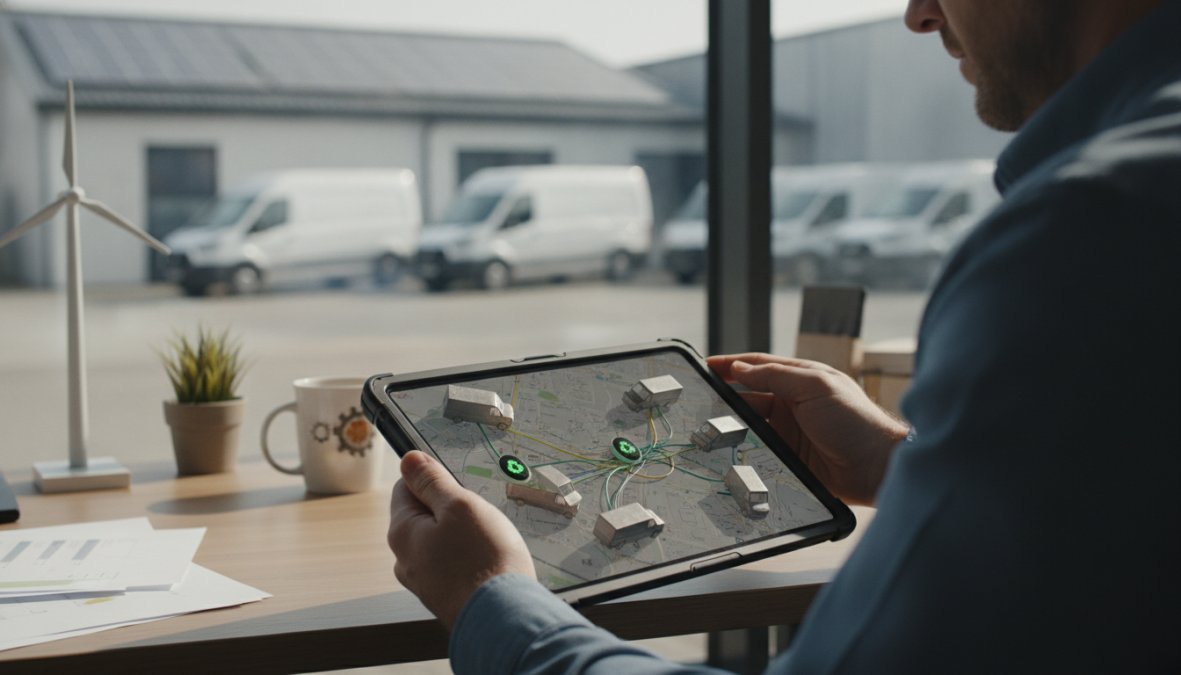
Telematics for emission reduction gives fleet managers real-time visibility into how, where, and how efficiently vehicles are being driven. Without that data, driver coaching is guesswork.
Real-Time Monitoring and Data Analytics
Modern telematics platforms capture continuous data: speed, acceleration, braking, idling time, fuel consumption, and engine diagnostics. The practical value lies in the patterns it reveals.
Real-time monitoring enables fleet managers to:
- Identify vehicles consuming more fuel than fleet average, flagging maintenance or driver behaviour issues
- Pinpoint routes with excessive idle time
- Track progress against carbon reduction targets on a rolling basis
- Spot unauthorised vehicle use
Telematics is most effective when data feeds directly into a management dashboard that surfaces exceptions automatically.
Driver Coaching and Performance Metrics
The technology is only as effective as the coaching programme built around it. Drivers who receive regular, specific feedback improve measurably. Drivers told only their score without context tend not to change behaviour.
Effective driver performance metrics include:
- Eco-driving score: A composite index covering acceleration, braking, cornering, and speed compliance
- Idling percentage: The proportion of engine-on time spent stationary
- Fuel efficiency ratio: Actual fuel consumption versus rated consumption
- Harsh event frequency: Harsh acceleration or braking events per 100 miles
Publishing anonymised league tables where drivers see how their score compares to fleet average produces stronger engagement than private feedback alone.
EV Fleet Transition Guide: Planning Your Journey
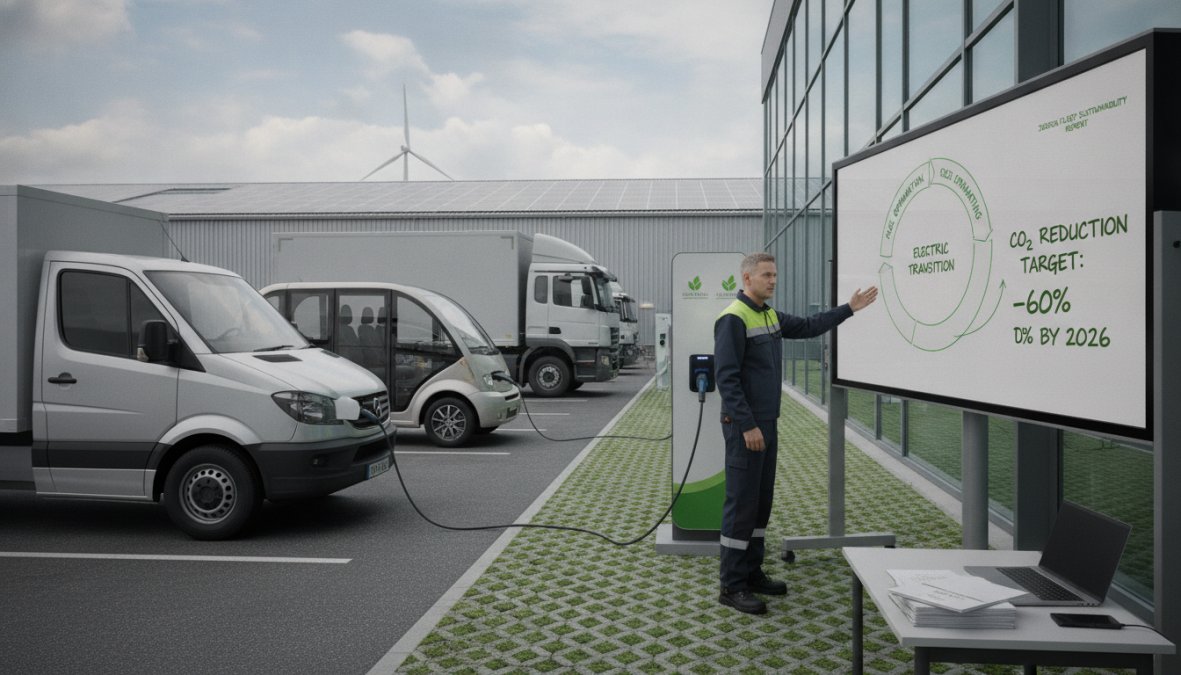
EV fleet transition is a structured programme with distinct phases, not a single procurement decision. Businesses that treat it as a continuous process succeed; those that treat it as a one-time event struggle.
Assessing Feasibility and Total Cost of Ownership
An EV fleet transition guide must start with honest feasibility assessment. Electric vehicles are not the right solution for every vehicle in every fleet at this moment. Key variables are daily mileage, access to charging, vehicle type, and payload requirements.
Total cost of ownership (TCO) analysis is the correct framework. TCO for an electric vehicle includes:
- Lease or purchase cost
- Electricity cost per mile versus diesel or petrol equivalent
- Servicing and maintenance (generally lower for EVs)
- Benefit-in-kind tax (currently favourable for zero-emission vehicles)
- Charging infrastructure investment
For businesses exploring electric and hybrid options, Electric / Hybrid Leasing provides access to a range of zero and low-emission vehicles, while Lease Used Electric Vehicles offers a cost-effective route into EV adoption. OVL Group's whole life cost analysis covers all variables, including finance, fuel, SMR, insurance, and tax, giving genuine like-for-like comparisons.
Charging Infrastructure and Operational Planning
Charging infrastructure is where many EV transition plans stall. Practical questions include: where do drivers park overnight, what is the electrical capacity at depot, and how will charging be managed for drivers without off-street parking?
A structured approach to charging infrastructure planning:
- Audit overnight parking: Identify what proportion of drivers have home charging access
- Assess depot capacity: Commission an electrical survey to determine whether existing supply can support workplace charging
- Model charging demand: Calculate peak charging demand based on vehicle return times and battery capacities
- Identify grant funding: The OZEV workplace charging scheme guidance provides financial support for businesses installing charge points
- Plan for public charging: Identify en-route public charging options and establish a reimbursement policy
Reducing Fleet Carbon Footprint: Quick Wins and Long-Term Gains
Fleet carbon reduction does not require a multi-year transformation before seeing results. There are actions producing measurable improvements within weeks, alongside structural changes that compound over years.
Immediate Actions You Can Take Today
Quick wins checklist:
- Conduct a tyre pressure audit and establish a monthly check protocol
- Pull 90 days of telematics data and identify top idling offenders
- Set a fleet speed policy capping motorway cruising at 60 mph
- Review fuel card data for anomalies suggesting unauthorised use or inefficient routing
- Identify highest-mileage vehicles approaching renewal and assess electric or hybrid feasibility
- Establish a baseline CO2e figure using DEFRA emission factors
Most actions require no capital expenditure, only time, data access, and management commitment.
Phased Implementation for Sustainable Change
Long-term fleet carbon reduction follows a predictable arc: measure, optimise behaviour, right-size, then electrify. Skipping phases, particularly moving straight to electrification without optimising the existing fleet, typically produces disappointing results and higher costs.
A practical phased framework:
Phase | Focus | Typical Timeframe | Primary Lever |
|---|---|---|---|
1 - Measure | Baseline and data collection | Months 1-3 | Fuel card and telematics data |
2 - Optimise | Driver behaviour and maintenance | Months 3-12 | Coaching and route planning |
3 - Right-size | Vehicle specification review | Months 6-18 | Procurement policy |
4 - Electrify | EV transition for suitable roles | Months 12-36 | Leasing and infrastructure |
5 - Report | Stakeholder and compliance reporting | Ongoing | Carbon accounting |
Measuring Success and Reporting Progress
Measurement without reporting is a missed opportunity. Businesses that formalise fleet carbon reporting consistently make faster progress than those treating it as an internal exercise.
Core metrics for fleet carbon reporting:
- Total fleet CO2e (tonnes): Absolute emissions for board-level reporting and year-on-year trend analysis
- CO2e per kilometre: Intensity metric normalising for changes in fleet size or activity
- CO2e per vehicle: Useful for benchmarking individual vehicles
- Percentage of zero-emission vehicles in fleet: Leading indicator of transition progress
Aligning fleet carbon reporting with broader corporate sustainability frameworks, such as the Science Based Targets initiative, raises the internal profile of fleet management and secures greater resource allocation.
According to the Carbon Trust's fleet carbon management guidance, establishing clear reporting cadences and assigning accountability at senior level are among the strongest predictors of sustained fleet carbon reduction over time.
A clear, consistent methodology applied quarterly using DEFRA emission factors and verified fuel data is more valuable than an elaborate framework that is difficult to maintain.
Fleet carbon management is complex, and the gap between intention and execution is where most programmes falter. OVL Group supports businesses with tailored vehicle leasing, whole life cost analysis covering finance, fuel, SMR, insurance, and tax, and dedicated account management that keeps fleet strategy aligned with operational reality. Whether you are starting with baseline measurement or planning a full EV fleet transition, explore Vehicle Leasing Special Offers and Van Leasing Special Offers to find the right solution for your fleet, then get in touch with OVL Group and take the first step towards measurable, sustainable reduction in your fleet's carbon output.
Frequently Asked Questions
How can businesses reduce their fleet carbon footprint without major capital investment?
Start with no-cost or low-cost measures: optimise routes using GPS data, implement driver training programmes to reduce fuel consumption, and maintain vehicles regularly to prevent efficiency loss. These actions can cut emissions by 10-15% immediately. For larger reductions, consider telematics systems that monitor real-time fuel use and driver behaviour. Phased implementation allows you to spread costs whilst achieving measurable results within months.
What is the role of telematics in reducing fleet emissions?
Telematics for emission reduction provides real-time visibility into vehicle performance, fuel consumption, and driver behaviour. The system identifies inefficient practices—harsh acceleration, excessive idling, speeding—and enables targeted driver coaching. Data analytics reveal patterns in fuel use across your fleet, helping you prioritise high-impact improvements. Combined with route optimisation, telematics typically reduces fuel consumption by 15-25% and extends vehicle lifespan by improving maintenance timing.
Is transitioning to electric vehicles cost-effective for reducing fleet carbon footprint?
EV fleet transition depends on your use case. For urban delivery, high-mileage routes, and vehicles replaced every 3-5 years, EVs offer strong long-term savings through lower fuel and maintenance costs. However, upfront capital, charging infrastructure requirements, and range limitations require careful planning. Conduct a whole-life cost analysis comparing total ownership costs—including finance, energy, maintenance, and residual value—against conventional vehicles. A phased approach, starting with routes best suited to EVs, reduces risk and spreads investment.
What fleet sustainability strategies deliver the quickest emissions reductions?
Fleet sustainability strategies with fastest impact include: route optimisation (5-10% reduction), driver behaviour change programmes (10-15% reduction), and vehicle right-sizing—replacing oversized vehicles with appropriately sized alternatives (8-12% reduction). Combining these three can achieve 20-30% emissions cuts within 6-12 months. Telematics accelerates results by providing data-driven insights. For deeper reductions beyond 30%, EV integration or vehicle replacement becomes necessary, requiring 2-5 year timescales.