Table of Contents
- Understanding the Shift: Why Domiciliary Care Operators Are Going Electric
- EV Charging Infrastructure for Domiciliary Care Operations
- Challenges of EV Adoption in Home Care Services
- Cost-Benefit Analysis of Electric Fleets in Healthcare Settings
- Government Grants and Funding for Electric Care Fleets
- Planning Your Transition: A Phased Approach to Transitioning Domiciliary Care Fleets to Electric
- Regulatory Compliance and Insurance Considerations
- Conclusion
Last Updated: June 2026
Pressure on care providers to cut emissions is growing fast, and transitioning domiciliary care fleets to electric has moved from aspiration to operational priority for 2026. The UK government's zero-emission vehicle mandate is tightening year by year, and home care operators who delay risk regulatory exposure and rising fuel costs that erode already-thin margins. This guidance reflects the real decisions, trade-offs, and costs involved in assessing your fleet, planning infrastructure, and making the financial case for going electric.
Understanding the Shift: Why Domiciliary Care Operators Are Going Electric
Domiciliary care fleets are structurally ideal candidates for electrification. Vehicles typically cover predictable daily routes, return to a base or staff home address each night, and rarely exceed the range ceiling of modern electric vans or cars in a single shift.
According to the UK Government's zero emission vehicle mandate guidance, all new cars and vans sold in the UK must be zero emission by 2035, with interim targets already creating pressure on fleet procurement decisions. Operators who begin transitioning now lock in lower whole-life costs before residual values on petrol vehicles deteriorate further.
Care workers increasingly ask about salary sacrifice EV schemes, and offering electric vehicles as part of a benefits package has become a genuine recruitment and retention tool in a sector where staff turnover is persistent.
EV Charging Infrastructure for Domiciliary Care Operations
Charging infrastructure is where most domiciliary care EV transitions either succeed or stall. Getting this right before vehicles arrive on fleet is non-negotiable.
Home Base Charging Solutions
A standard 7kW AC wall box will fully charge most electric cars overnight and most light commercial vans in 8-10 hours. For fleets requiring faster turnaround, 22kW chargers offer roughly three times the charging speed where the vehicle's onboard charger supports it.
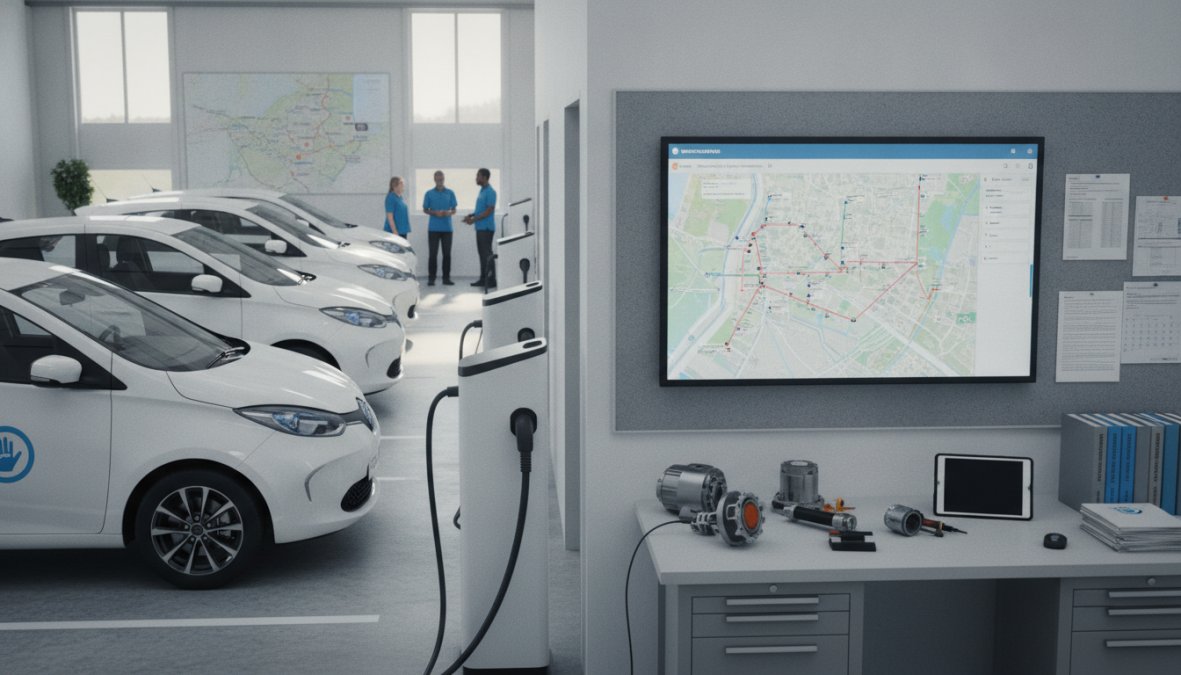
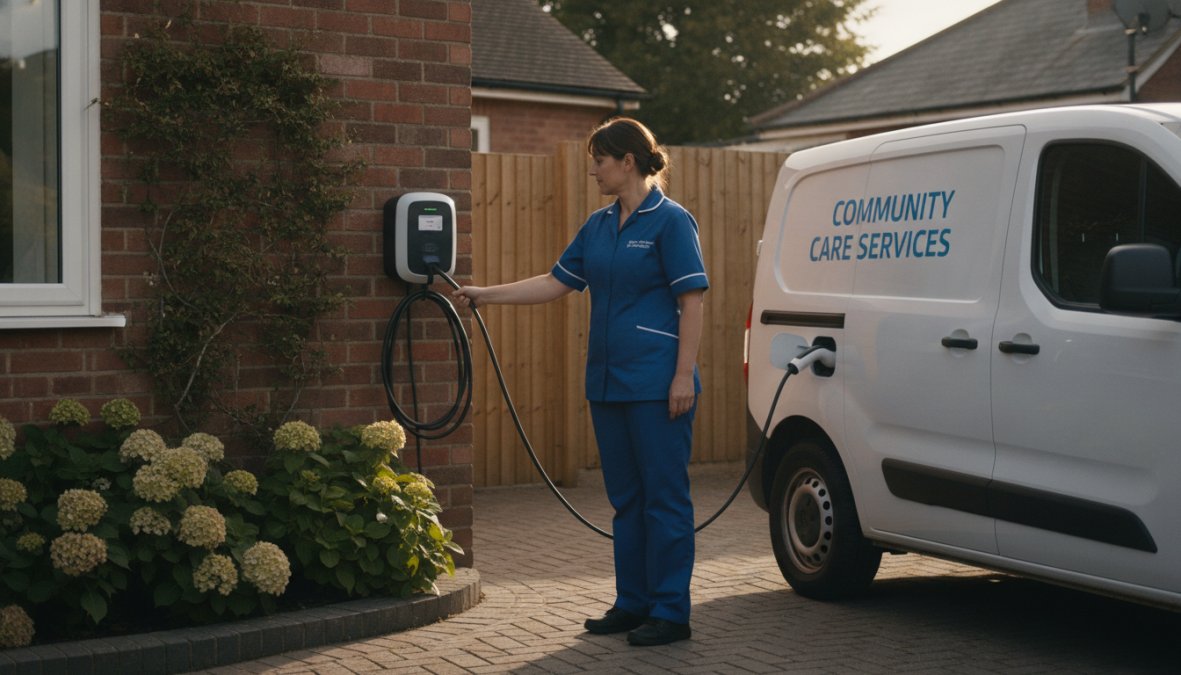
For domiciliary care, a hybrid approach works well: depot charging for the core fleet, combined with home charging support for staff who use employer vehicles and park at home overnight. The OZEV workplace charging scheme guidance provides funding support for eligible businesses installing charge points at their premises.
On-the-Road Charging Networks
The UK's public rapid charging network has expanded considerably, but coverage remains uneven. Urban care operators will find adequate rapid charging options nearby. Rural operators face genuine gaps, and route planning tools and telematics data become essential.
Map your highest-mileage routes first and identify where the nearest 50kW or 150kW rapid chargers sit relative to your care visit clusters. Most modern electric vehicles with real-world ranges of 200 miles or more will complete a full day of domiciliary care visits without needing a public charge. The public network serves as a safety net, not a primary charging solution.
Challenges of EV Adoption in Home Care Services
The challenges of EV adoption in home care are real, but most are manageable with proper planning.
Range Anxiety and Service Coverage
Range anxiety is often overstated. The average domiciliary care worker covers far less daily mileage than the range ceiling of current-generation electric cars. However, rural operators whose staff cover dispersed geographic areas with long inter-visit distances face genuine concerns.
Pull your current fleet's telematics or mileage logs, calculate the 95th percentile daily distance for each driver, and select vehicles whose real-world range comfortably exceeds that figure with a buffer. For genuinely high-mileage rural routes, a plug-in hybrid may be the right transitional choice while infrastructure catches up.
Upfront Capital Investment
The upfront cost of electric vehicles remains higher than equivalent petrol or diesel alternatives. The total capital outlay covers vehicles, charge point hardware, installation, and potentially grid upgrades.
Leasing, rather than outright purchase, is the most common route for care fleet operators managing this cost. Operating lease structures spread capital costs, preserve cash flow, and transfer residual value risk to the leasing provider. A whole-life cost analysis typically shows that the higher monthly lease cost of an EV is partially or fully offset within the lease term through fuel savings and reduced maintenance.
Cost-Benefit Analysis of Electric Fleets in Healthcare Settings
Total cost of ownership (TCO) is the correct metric for fleet procurement decisions. TCO covers finance costs, fuel or energy costs, scheduled maintenance, tyres, insurance, and end-of-life residual value. Electric vehicles generally outperform petrol equivalents on TCO over a three-to-five-year fleet cycle, primarily because of lower energy costs per mile and significantly reduced maintenance requirements.
Benefit-in-kind (BIK) tax treatment is a major factor for care operators running company car schemes. Electric vehicles attract a 2% BIK rate, compared to 25-37% for petrol and diesel vehicles. For employees taking a vehicle through a salary sacrifice scheme, this difference represents meaningful monthly savings.
| Cost Factor | Petrol/Diesel Fleet | Electric Fleet |
|---|---|---|
| Fuel/energy cost per mile | Higher (variable with fuel prices) | Lower (stable electricity rates) |
| Scheduled servicing | More frequent, higher cost | Less frequent, lower cost |
| Benefit-in-kind tax rate | 25-37% (emissions-dependent) | 2% |
| Residual value risk | Declining as ICE demand falls | Improving as EV demand grows |
| Government grant eligibility | Limited | Multiple schemes available |
| Road tax (VED) | Standard rates apply | Zero for zero-emission vehicles |
Electric vehicles have fewer moving parts than internal combustion engines. There is no exhaust system, no clutch on most models, no oil changes, and no timing belt replacements. Brake wear is reduced through regenerative braking. For care fleets covering high annual mileage, these maintenance savings accumulate meaningfully over the fleet lifecycle.
Real-time monitoring through fleet telematics gives fleet managers visibility of vehicle health, charge state, and driver behaviour in one dashboard. This supports proactive maintenance scheduling rather than reactive repairs, which is particularly important for care operators where vehicle availability directly affects service delivery.
Government Grants and Funding for Electric Care Fleets
Government grants for electric care fleets represent a meaningful offset against upfront investment, and many operators fail to claim everything they are entitled to.
The primary funding routes available to care operators in 2026 include:
- Workplace Charging Scheme (WCS): Provides a grant contribution towards the cost of purchasing and installing workplace EV charge points.
- LEVI (Local Electric Vehicle Infrastructure) Fund: Targeted at local authority and community charging infrastructure, which can benefit care operators in areas where public charging is limited.
- NHS and local authority fleet decarbonisation programmes: Some integrated care systems and local authorities have ring-fenced funding to support care provider fleet transitions as part of their own net-zero commitments.
- Enhanced Capital Allowances: Businesses can claim 100% first-year capital allowances on qualifying EV charge point equipment, reducing the effective cost of infrastructure investment.
According to the Energy Saving Trust's fleet electrification guidance, care and health sector operators are among the most eligible for public funding support given their social value and high-mileage operational profiles.
Planning Your Transition: A Phased Approach to Transitioning Domiciliary Care Fleets to Electric
The most common mistake care operators make is trying to convert everything at once. A phased approach reduces risk, allows learning, and avoids cash flow strain.
Assess Your Current Fleet and Service Requirements
Start with data. Pull your current fleet's mileage records, service history, and vehicle age profile. Identify which vehicles are coming up for renewal in the next 12-24 months. These are your natural entry points for EV replacement.
A useful fleet audit checklist:
- Total number of vehicles and current lease/ownership status
- Average and maximum daily mileage per vehicle
- Geographic coverage area and rural/urban split
- Current fuel spend per vehicle per month
- Upcoming lease renewal dates
- Staff vehicle usage patterns (pool fleet vs. named driver)
- Current parking and overnight storage arrangements
- Existing electrical infrastructure at depot or office
Evaluate Vehicle Types and Range Needs
Not every vehicle in a domiciliary care fleet has the same requirements. A coordinator's car covering 40 miles per day has different needs from a community nurse's van covering 120 miles across a rural patch. Match vehicle selection to actual route requirements rather than applying a one-size-fits-all approach.
For most urban and suburban care operators, a pure battery electric vehicle with a real-world range of 200 miles or more covers the full working day comfortably. For high-mileage rural routes, a plug-in hybrid provides electric-only running for the majority of journeys while the petrol range extender removes range anxiety on longer days.
Build Your Charging Infrastructure Plan
Infrastructure planning should run in parallel with vehicle selection. Key infrastructure decisions to resolve before procurement include depot charging capacity, home charging for staff, grid capacity requirements, and smart charging management capabilities.
According to Zap-Map's UK charging infrastructure data, the number of public charge points in the UK has grown substantially year-on-year, but distribution remains weighted towards urban areas. Rural care operators should not rely on public infrastructure as a primary charging solution.
Regulatory Compliance and Insurance Considerations
Transitioning to electric introduces new compliance requirements alongside existing ones.
Driver licence and vehicle category: Most electric cars and light vans fall within standard B licence categories. No additional licensing is required for drivers already authorised to drive petrol equivalents.
Fleet insurance: Electric vehicles can attract different insurance premiums. Shopping the market at renewal with EV-specific fleet insurance products is worthwhile. A well-maintained fleet with telematics-evidenced driver behaviour data is a strong negotiating position with insurers.
Driver behaviour monitoring: Electric vehicles are typically equipped with sophisticated onboard diagnostics. Telematics integration gives fleet managers real-time visibility of driver behaviour, supporting both risk management and insurance premium negotiations.
Documentation and audit trail: Cloud-based fleet management systems consolidate vehicle inspection records, service history, charge point maintenance logs, and driver declaration records into a single audit trail, simplifying both internal governance and external inspection.
MOT and roadworthiness: Electric vehicles are subject to the same MOT requirements as petrol vehicles from their third year. Ensuring your service provider is accredited to work on electric vehicles is essential.
Transitioning domiciliary care fleets to electric is one of the most consequential fleet decisions a care operator will make this decade. OVL Group provides whole-life cost analysis, dedicated account management, and tailored electric and hybrid leasing solutions designed specifically for organisations with complex operational requirements. Explore OVL Group's electric and hybrid leasing options or browse current [van leasing special offers](https://www.ovl.co.uk/van-leasing/special-offers) to see what is available for your fleet today.
Frequently Asked Questions
What are the main challenges of transitioning care fleets to electric vehicles?
The primary challenges include range limitations for multi-visit routes, upfront capital investment in vehicles and charging infrastructure, and the need to retrofit existing facilities with charging points. Home care operators also face driver training requirements and potential service coverage gaps in areas with limited public charging networks. However, phased transitions and careful route planning can mitigate these concerns.
How much does it cost to install EV charging infrastructure for domiciliary care?
Installation costs vary significantly depending on property type and electrical capacity. Home-based charging points typically require £500-£2,000 per installation, whilst commercial charging hubs may cost £3,000-£15,000 per unit. Many organisations access government grants that offset 75-100% of installation costs, making the net expense considerably lower. Whole life cost analysis is essential to understand long-term savings.
Are government grants available for electric care fleet transitions?
Yes. The UK offers several funding schemes for fleet electrification, including grants for charging infrastructure installation and vehicle purchase incentives for eligible organisations. The level of support varies by region and fleet size. Home care providers should research local authority schemes and national programmes. Specialist fleet advisors can help identify and apply for available funding to reduce transition costs.
What is the cost-benefit analysis of transitioning domiciliary care fleets to electric?
Electric vehicles typically offer lower fuel costs (60-70% savings versus petrol), reduced maintenance expenses, and potential insurance discounts. When combined with government grants and salary sacrifice schemes, the total cost of ownership becomes competitive within 3-5 years. Benefits extend beyond finances: improved air quality, enhanced brand reputation, and reduced regulatory risk. A detailed whole life cost analysis tailored to your service area and visit patterns is essential for accurate projections.