Table of Contents
- Why Electric Fleet Transition Is Necessary for SMEs: The Business Case
- Cost-Benefit Analysis of Electric Fleet Transition
- Environmental Impact and Sustainability Goals
- EV Charging Infrastructure for SMEs
- Government Grants for Electric Commercial Vehicles
- Overcoming Fleet Electrification Challenges
- Fleet Management Software and Telematics Integration
- Creating Your EV Fleet Transition Roadmap
Why Electric Fleet Transition Is Necessary for SMEs
Last Updated: July 10, 2026
The shift toward electric vehicles represents one of the most significant operational decisions SMEs will face in the coming years. Understanding why electric fleet transition is necessary goes beyond environmental compliance, it addresses fundamental business economics, operational efficiency, and long-term competitiveness. Early movers gain decisive advantages in cost control, brand positioning, and workforce retention.
This guide explores the complete business case for fleet electrification, from financial analysis to practical implementation strategies. Whether you're managing five vehicles or fifty, electrification is no longer optional for businesses seeking sustainable growth.
Why Electric Fleet Transition Is Necessary for SMEs: The Business Case
Rising fuel costs, stricter emissions regulations, and changing customer expectations create converging pressures that make traditional combustion fleets increasingly untenable. Fuel expenses typically consume 20-30% of total fleet operating budgets, a proportion that continues to climb.
Local authorities across the UK are introducing low-emission zones that penalise older diesel vehicles. London's Ultra Low Emission Zone (ULEZ) charges non-compliant vehicles £12.50 per day. For SMEs with delivery routes in urban areas, these charges compound quickly.
Younger employees increasingly expect employers to demonstrate environmental commitment. Companies that transition to electric vehicles often report improved recruitment outcomes and stronger employee engagement around sustainability.
The financial case is compelling. Electric vehicles have lower operational costs per mile than petrol or diesel equivalents. Electricity is cheaper than fuel, maintenance is dramatically reduced, and many SMEs qualify for government grants that offset purchase costs.
Cost-Benefit Analysis of Electric Fleet Transition
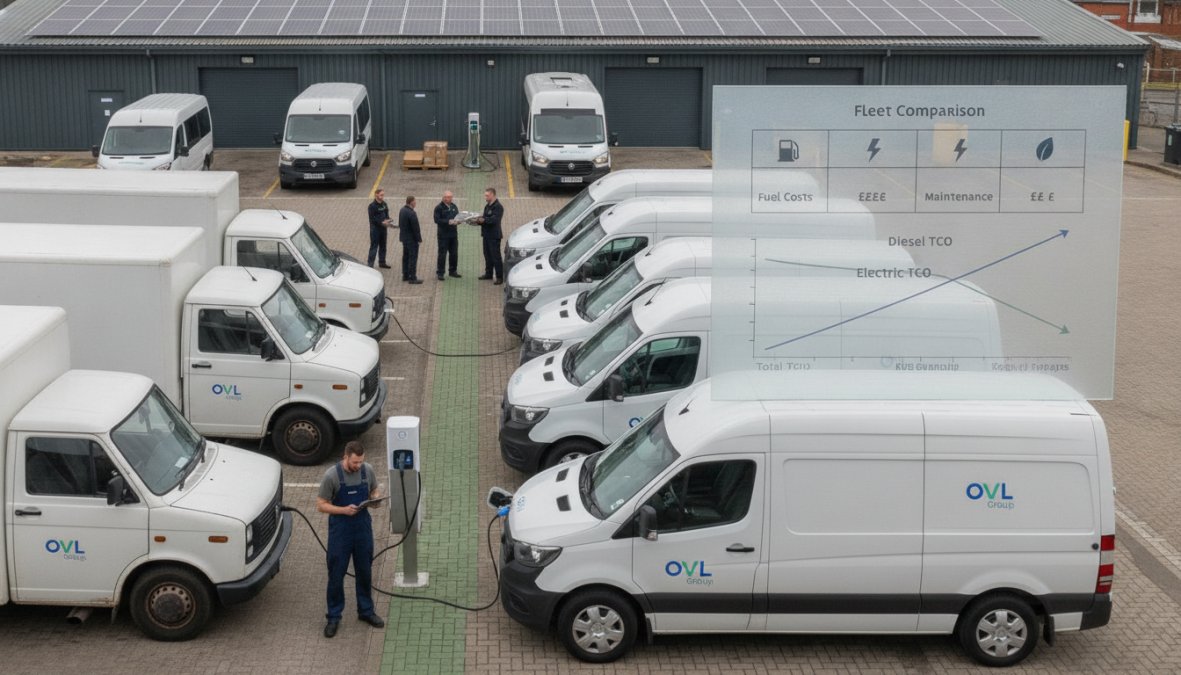
Understanding total cost of ownership (TCO) is essential for SMEs evaluating fleet electrification. A comprehensive analysis includes fuel, maintenance, insurance, depreciation, and tax implications across the vehicle's entire lifespan.
Total Cost of Ownership: Beyond Fuel Savings
The total cost of ownership for electric vehicles typically favours EVs within 3-5 years of operation. Electricity costs roughly one-third the price of diesel per mile. A typical commercial EV charging at workplace rates costs around 4-5p per mile, compared to 12-15p per mile for diesel. Over 75,000 miles (a common five-year total), that's a saving of £6,000-£8,000 in fuel alone.
Maintenance costs drop significantly. Electric vehicles have no oil changes, spark plugs, or timing belts. Brake pads last longer because regenerative braking does most of the stopping. Fleet operators typically report 40-50% reductions in maintenance costs compared to diesel vehicles, approximately £2,000-£3,500 per vehicle over five years.
Insurance premiums for electric vehicles are increasingly competitive as EV adoption grows and insurers accumulate claims data.
SME-Specific Financial Risk Mitigation
For SMEs, financial risk is the primary concern. Whole-life leasing arrangements convert large capital expenditures into predictable operational costs, protecting cash flow and simplifying budgeting. Leasing also mitigates technology risk, your fleet always uses current-generation vehicles with modern range and efficiency. Electric / Hybrid Leasing options are specifically designed to support this transition, offering comprehensive packages that include maintenance, support, and fleet management integration.
Government grants and incentives further reduce financial exposure. The Office for Zero Emission Vehicles (OZEV) provides grants covering 20-40% of vehicle costs, dramatically improving the financial case.
Environmental Impact and Sustainability Goals
The environmental case for fleet electrification extends beyond carbon footprint reduction to air quality, noise pollution, and alignment with corporate sustainability commitments that increasingly influence customer and investor decisions.
Reducing Carbon Footprint and Emissions
Electric vehicles produce zero tailpipe emissions. Over a vehicle's lifetime, an EV produces approximately 50-70% fewer greenhouse gas emissions than a comparable diesel vehicle, even accounting for electricity grid composition. As electricity grids incorporate more renewable energy, this advantage grows.
For SMEs with sustainability commitments to customers or investors, fleet electrification provides measurable proof of environmental progress and supports ESG reporting initiatives.
Meeting Corporate Sustainability Expectations
Customers increasingly expect suppliers to demonstrate environmental responsibility. Many large retailers now require supply chain partners to reduce emissions. For SMEs supplying these businesses, fleet electrification is a competitive requirement.
Employee expectations matter equally. Surveys show younger workers prioritise working for environmentally responsible employers. A company operating modern electric vehicles signals sustainability commitment during recruitment and retention efforts.
EV Charging Infrastructure for SMEs
Charging infrastructure represents the most significant operational change when transitioning to electric vehicles. Planning this correctly determines whether your fleet operates smoothly or faces constant constraints.
Planning Your EV Charging Installation and Capacity
Most SMEs charge vehicles overnight at their depot or office location. A typical commercial setup includes 7-22kW wallbox chargers that replenish a vehicle's battery overnight. A 7kW charger adds approximately 20-30 miles of range per hour; a 22kW charger adds 60-80 miles per hour.
For a five-van operation with typical daily routes of 80-120 miles, overnight charging at 7-11kW capacity usually suffices. The installation process involves site survey, charging hardware installation (typically £1,500-£3,500 per unit), integration with fleet management systems, and staff training. Most installations complete within 4-8 weeks.
Grid Capacity and Site Upgrades
Upgrading site electrical capacity is often necessary but frequently overlooked. A single 22kW charger draws significant current; multiple chargers draw even more. Many older commercial buildings require consultation with electricity suppliers and potentially significant infrastructure investment.
Time-of-use charging strategies help manage grid demand. Charging vehicles during off-peak hours (typically 10pm-6am) costs less and reduces strain on local infrastructure. Most fleet management systems can schedule charging automatically during these windows.
Government Grants for Electric Commercial Vehicles
Government support for commercial EV adoption significantly improves the financial case. Multiple funding schemes exist, though eligibility criteria vary.
Available Incentive Programmes and Eligibility
The Office for Zero Emission Vehicles (OZEV) administers grant programmes for commercial vehicles, providing grants covering up to 20% of vehicle purchase costs. Typical grants range from £2,000-£8,000 per vehicle depending on vehicle type.
Eligibility generally requires UK business registration, operation of vehicles in the UK, and purchase of new or nearly-new electric vehicles. Many local authorities offer additional grants beyond OZEV schemes. Check with your local authority and the OZEV website for current eligibility before committing to vehicle purchases.
Tax benefits also apply. Electric vehicles qualify for enhanced capital allowance, allowing businesses to deduct 100% of purchase costs against taxable profits in the year of purchase, effectively reducing net acquisition costs.
Overcoming Fleet Electrification Challenges
Despite clear financial and environmental benefits, SMEs face practical obstacles when transitioning fleets. Understanding these challenges and implementing solutions ensures successful transitions.
Change Management for Drivers and Staff
Driver acceptance is often the largest implementation challenge. Electric vehicles feel different, different acceleration characteristics, braking behaviour, and controls. Without proper training and support, driver resistance can undermine an otherwise sound transition.
Successful change management involves early communication, hands-on training (at least two hours covering charging and vehicle operation), ongoing support, and peer champions who mentor others. Many drivers report preferring electric vehicles after a brief adjustment period due to smoother acceleration, quieter operation, and lower running costs.
EV Range Anxiety and Route Planning
Most commercial electric vehicles offer 150-300 miles of range per charge, covering the vast majority of daily delivery and service routes. Effective route planning addresses range concerns directly by mapping current routes, identifying charging locations along common routes, and using fleet management software with EV-specific routing.
Real-world data shows that range anxiety diminishes significantly once drivers experience actual vehicle performance. A vehicle with 200-mile range easily covers 100-150 miles daily with overnight charging, providing substantial safety margins.
Exploring the Used EV Market for Cost-Effective Transition
The used EV market offers cost-effective alternatives for SMEs with budget constraints. Five-year-old EVs with 100,000 miles typically retain 70-80% of original battery capacity. Used EV prices have fallen 30-40% over the past two years, making used vehicles attractive, typically £15,000-£25,000 compared to £35,000-£50,000 for new equivalents.
Leasing used electric vehicles offers additional advantages with lower monthly payments and included maintenance. For SMEs testing electrification with a small pilot fleet, leasing used vehicles minimizes financial risk while generating real operational data.
Fleet Management Software and Telematics Integration
Electric vehicles generate substantially more data than traditional vehicles. Properly managed, this data drives operational efficiency improvements that amplify electrification benefits.
Monitoring EV Battery Health and Performance
Modern fleet management systems track battery health continuously, including state of charge, charging speed, temperature, and degradation trends. Early warning systems alert fleet managers to potential issues before they impact operations. Battery health monitoring enables predictive maintenance, charging optimization, driver coaching, and warranty management.
Optimising Operational Efficiency with Data
Fleet management software transforms raw vehicle data into actionable insights. Real-time dashboards show vehicle locations, battery levels, and efficiency metrics. Historical analysis identifies patterns and improvement opportunities.
Typical efficiency gains from data-driven management include 8-12% energy consumption reduction per mile through driver coaching, 15-20% vehicle utilisation improvement, 10-15% charging cost reduction through time-of-use scheduling, and 20-25% maintenance cost reduction through predictive maintenance. A five-van fleet might reduce annual operating costs by £8,000-£12,000 through systematic data application.
Creating Your EV Fleet Transition Roadmap
Successful fleet electrification requires structured planning. A phased approach allows SMEs to learn from early vehicles, refine processes, and manage financial exposure.
Phase-by-Phase Implementation Strategy
Phase 1: Assessment and Planning (Months 1-3)
Conduct a thorough audit of current operations: document all vehicles, annual mileage, routes, and driver assignments; map charging infrastructure requirements; assess electrical capacity; identify government grants; and calculate total cost of ownership. This phase typically costs £3,000-£8,000 but prevents costly mistakes.
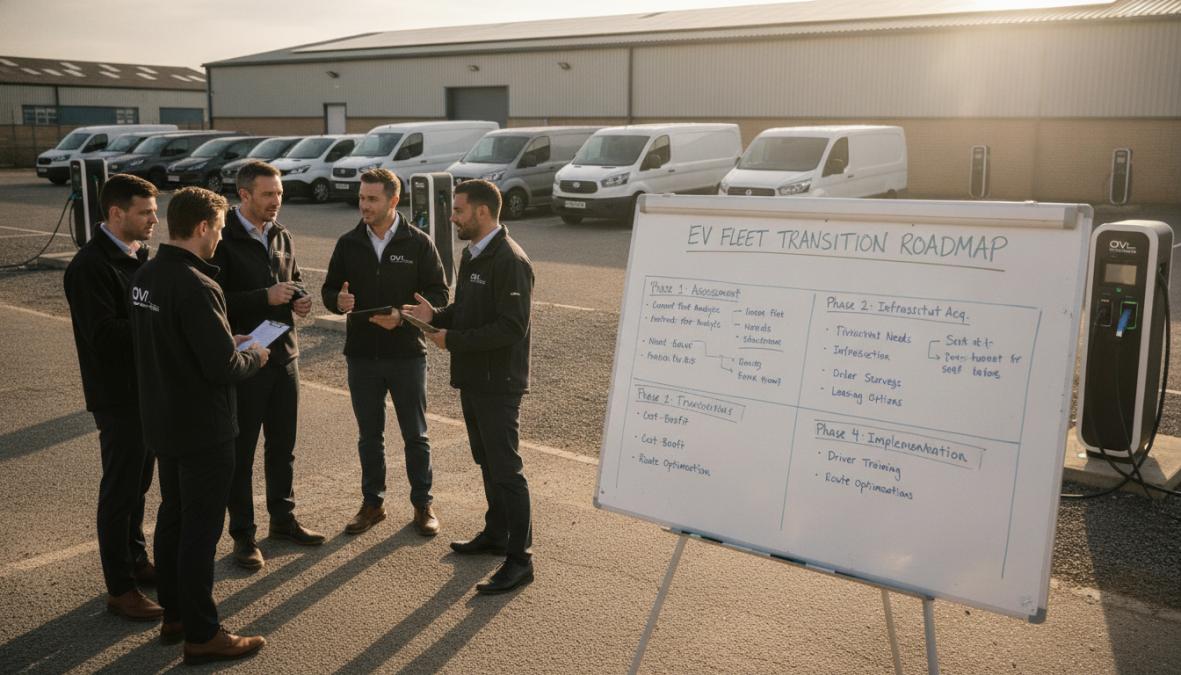
Phase 2: Pilot Deployment (Months 4-9)
Introduce 1-2 electric vehicles matching your most common routes. Use this phase to test charging infrastructure, train drivers, gather real-world performance data, and refine operational processes. Pilot vehicles should operate for at least 6 months to generate meaningful data.
Phase 3: Infrastructure Expansion (Months 10-15)
Based on pilot learnings, expand charging infrastructure and upgrade electrical capacity if needed. This phase typically costs £8,000-£20,000 depending on site requirements.
Phase 4: Fleet Transition (Months 16-36)
Replace remaining fleet vehicles systematically, prioritising vehicles with highest annual mileage and those operating on consistent routes.
Tailored Leasing Solutions for SME Fleet Needs
Leasing offers significant advantages for SMEs navigating electrification. Comprehensive arrangements typically include vehicle provision, maintenance, tyre replacement, breakdown assistance, insurance, fleet management software, and warranty coverage. Monthly payments are predictable, simplifying budgeting. If technology changes or business needs shift, you're not locked into outdated vehicles.
Leasing also provides access to the latest vehicle technology. As electric vehicle performance improves, your fleet automatically benefits from newer models with better range and efficiency. Vehicle Leasing Special Offers and Van Leasing Special Offers can help reduce your transition costs further.
Fleet electrification represents one of the most significant operational decisions SMEs face today. Rising fuel costs, regulatory pressure, and changing customer expectations make the transition increasingly urgent. The financial case is compelling, lower operating costs, government support, and tax benefits create positive returns within 3-5 years. The operational case is equally strong: improved efficiency, reduced maintenance, and enhanced brand positioning deliver lasting competitive advantages.
Frequently Asked Questions
What are the main financial benefits of electric fleet transition for SMEs?
Electric fleet transition reduces operational costs through lower fuel and maintenance expenses compared to traditional vehicles. Total cost of ownership typically improves over the vehicle lifecycle due to reduced servicing, lower energy costs, and potential government incentives. Additionally, many SMEs benefit from improved cash flow through tailored leasing arrangements that spread costs predictably, rather than purchasing vehicles outright.
How can SMEs afford EV charging infrastructure installation?
EV charging infrastructure costs depend on your site's electrical capacity and the number of charging points required. Government grants for electric commercial vehicles can offset installation expenses significantly. Many SMEs also benefit from phased implementation, installing essential charging capacity initially and expanding as the fleet grows. Professional consultation ensures you invest in the right charging solutions without over-specification.
Are electric vehicles cheaper to maintain than petrol or diesel fleet vehicles?
Yes, electric vehicles typically have lower maintenance costs because they have fewer moving parts, no oil changes, and reduced brake wear due to regenerative braking. Battery health monitoring through fleet management software helps predict maintenance needs, reducing unexpected downtime. Over a vehicle's lifecycle, maintenance savings contribute meaningfully to the total cost of ownership advantage of EV adoption.
What government grants are available for SME electric fleet transition?
Government incentive programmes support electric commercial vehicle adoption, though eligibility and grant amounts vary by region and vehicle type. Grants may cover vehicle purchase costs or charging infrastructure installation. Current schemes reward businesses that demonstrate commitment to emissions reduction and sustainability goals. Contact relevant government bodies or your fleet provider for details on available programmes and application processes for your specific situation.